


This week has been different. For the first time since the start of the war we started getting dovish signals from the US. Whatever is your opinion on the feasibility of the ceasefire, it is the first time the US publicly entertained a real option to end the conflict.
Along with this narrative, we also saw main demands from the US and Iran. Next to a “kinetic negotiation” of war, a diplomatic track was opened. While there is a long way between opening a diplomatic track (eg. the diplomatic track in Ukraine war has been open since early 2025), we now have new information that is necessary to assess.
As there is a lot of conflicting information, I need to go through both aspects of the negotiation and derive the path we are on.
The Diplomatic Track
First news of an opening of a diplomatic track hit us on Monday with this post from Trump:
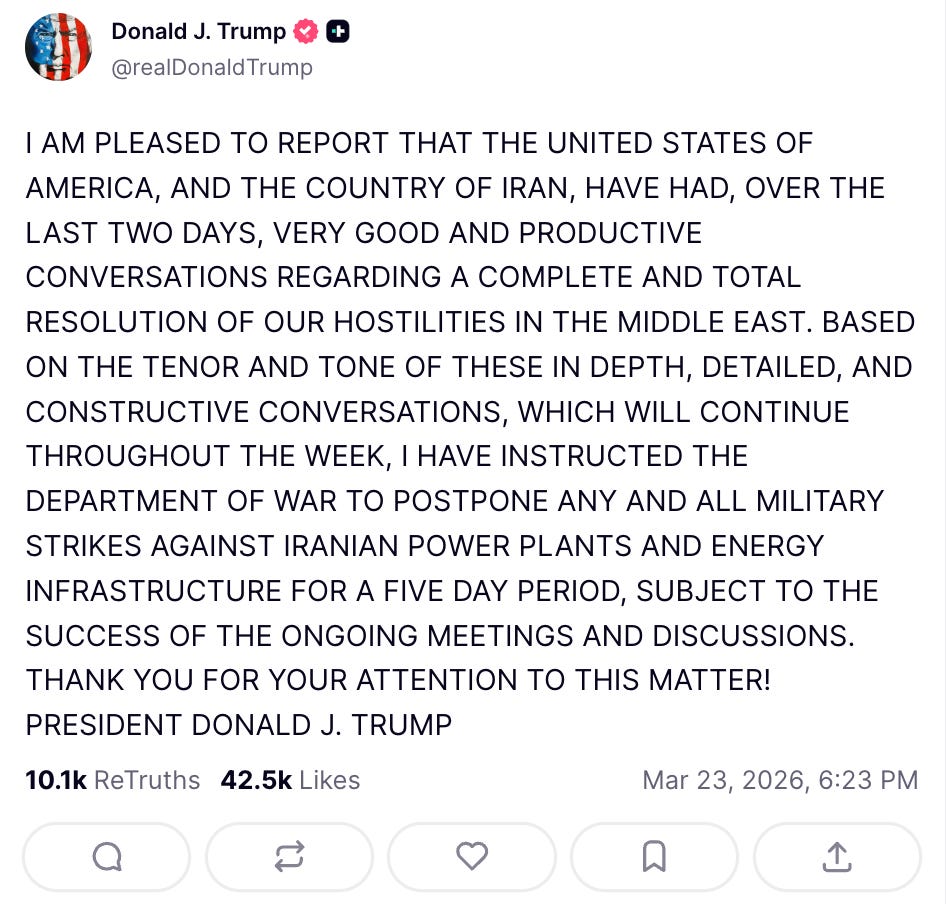
Since then we learned the respective position of the two sides with regards to ending the conflict.
The US (rumored):
Removal of all sanctions on Iran.
US assistance in advancing and developing a civilian nuclear project (electricity generation).
Removal of the threat of sanctions being reimposed.
Iran’s nuclear program is frozen under a defined framework.
Enriched uranium to remain, but under supervision and agreed limits.
Missile program to be addressed at a later stage, with limits on quantity and range.
Use of nuclear programs restricted to civilian/defensive purposes only.
Development of existing nuclear capabilities halted.
No further expansion of enrichment capabilities.
No production of weapons-grade nuclear material on Iranian soil.
All enriched material to be handed over to the IAEA within an agreed timeline.
Natanz, Isfahan and Fordow to be taken out of use (destroyed).
International monitoring and verification mechanisms enforced.
Gradual implementation tied to compliance.
Additional regional and security understandings between the parties.
Iranian response:
The enemy’s aggression and acts of assassination come to an end.
Objective conditions are established to ensure that the war will not reoccur.
The payment of damages and war reparations is guaranteed and clearly determined.
The end of the war is implemented across all fronts and for all resistance groups involved in this conflict throughout the region.
Iran’s exercise of sovereignty over the Strait of Hormuz is its natural and legal right and guarantees for the implementation of the other party’s commitments must be recognized.
These seem pretty far apart, but the real conclusion is that both sides are rather still talking past each other.