


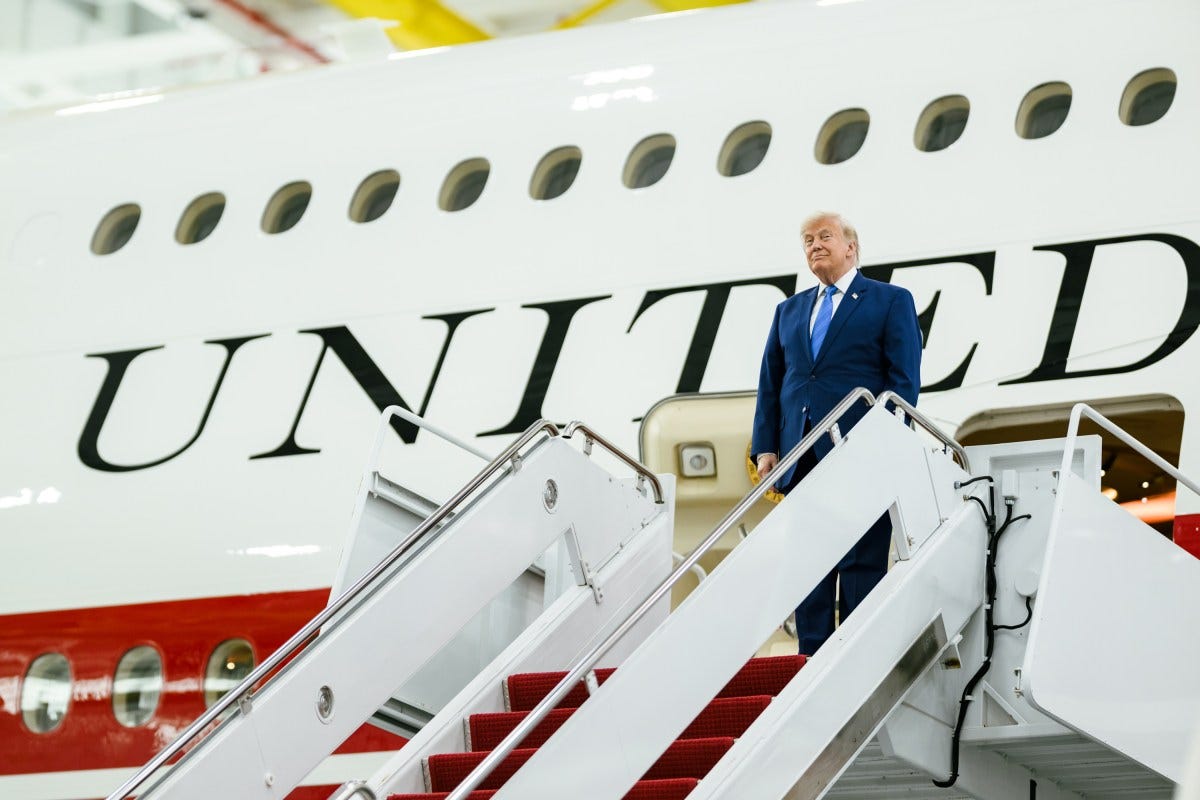
Welcome to another week! Trump once again stopped a massive escalation hours before his threat expired. Iran and the US are supposed to negotiate again starting today as tensions in the region run high. Outside of that, the Middle East saw developments across Yemen and Gaza.
Other parts of the world didn’t sleep. From the Fed’s decision to Chinese tech advancements and Ceuta, it has been a busy week across the board.
Each week I gather all the relevant news from around the world and provide my commentary in my Global Outlooks. This way you can look under the hood and see how a geopolitical trader thinks about the world. Paid subscribers go a level deeper: my full Iran and Ukraine war coverage, election deep dives, and the fair values I'm actually trading on.
Let’s see what changed in the world!
Weekly Outlook
US Inc.
America banned imports of humanoid robots, citing “unacceptable risks” to national security. The Federal Communications Commission said “advanced robotic devices”, which are mostly made in China, could “surveil Americans”. The regulator also blocked foreign-made power inverters, which are used in data centers and solar panels. China accused America of protectionism.
Comment: America can feel China breathing down its neck, both in robotics and AI. Trump is a protectionist at heart and naturally his first instinct is to block access to Chinese tech. Protecting frontier industries is not inherently bad, and surveillance makes a convenient cover story for the real reason: Chinese frontier tech is almost on par with America's.
America’s economy grew more slowly than expected in Q2, expanding by an annualized 1.5%. Consumer spending grew by 3.2% thanks to slowing energy inflation and higher-than-usual tax refunds, and AI-driven investment continued to boom. Growth was offset by a decline in net exports and companies drawing down their inventories.
Comment: the positives continue to cover up the negatives and the K-shaped paths continue to diverge. The second half of the year is the one to watch, however. The effects of the Strait of Hormuz blockade, combined with extreme weather caused by El Niño, should show themselves in the price of energy, downstream manufacturing and food. I focus more on El Niño in the Europe section.
The Federal Reserve left the interest rate unchanged at 3.5% to 3.75%. Three of the 12 members of the FOMC voted for a 25bps increase. Kevin Warsh, the new chairman, urged patience in bringing inflation down and said the Fed would “not hesitate to act” when necessary. American stocks fell and 2Y Treasury yields declined.
Warsh is also considering reducing the number of rate-setting meetings held each year. The policy committee currently meets eight times; Warsh reportedly believes fewer meetings would draw less attention to the Fed.
Comment: Kevin Warsh clearly wants the markets to set their own rate before he acts. By refusing to provide forward guidance he forces the market to react to the incoming economic data. This way, the Fed gets another, valuable data point—unobstructed market sentiment. I expect a few more interesting meetings as Warsh’s approach becomes clearer.
Trump said Todd Blanche will remain acting attorney-general even if two Republican senators continue to block his confirmation. Trump also vowed to revive the $1.8bn “anti-weaponization” fund, designed to pay his MAGA allies, which he had previously abandoned. The senators have refused to approve Blanche without assurances that the Justice Department will not create the fund.
Comment: another Trump grift. It’s rather inconsequential for global affairs and traders expect Todd Blanche to be confirmed before the midterms.
Anthony Fauci, the chief medical adviser to the White House during the COVID-19 pandemic, repeatedly invoked his Fifth-Amendment right not to answer questions during a Senate hearing on the origins of the virus. Rand Paul, the Republican senator chairing the committee, said lawmakers would vote on holding Fauci in contempt. Fauci, who retired in 2022, accused Paul of an “unhinged obsession” with him.
Comment: MAGA wants justice on COVID and MAGA will get it. Traders see a fair chance Fauci is charged by the end of the year. I’m inclined to agree.
The Americas
Keiko Fujimori was inaugurated as Peru’s president after winning June’s runoff by fewer than 50,000 votes. The daughter of former president Alberto Fujimori becomes the country’s ninth president in a decade.
Comment: I wonder if she has her father’s inclinations to stay in power…
Brazil recalled its ambassador to Argentina after Javier Milei attacked Lula and a Supreme Court justice at Flávio Bolsonaro’s campaign kick-off rally, calling Brazil’s president a “thief” and a “former convict”. Brazil’s foreign minister summoned Argentina’s ambassador to express “revulsion”.
Comment: Brazil is one of the few LatAm countries where the left is ahead of the right. Milei's move serves two purposes: helping Trump pull LatAm to the right and toward the US, and securing a politically aligned neighbor. However, I’m not sure Milei’s popularity can translate into more votes for Bolsonaro.
Asia
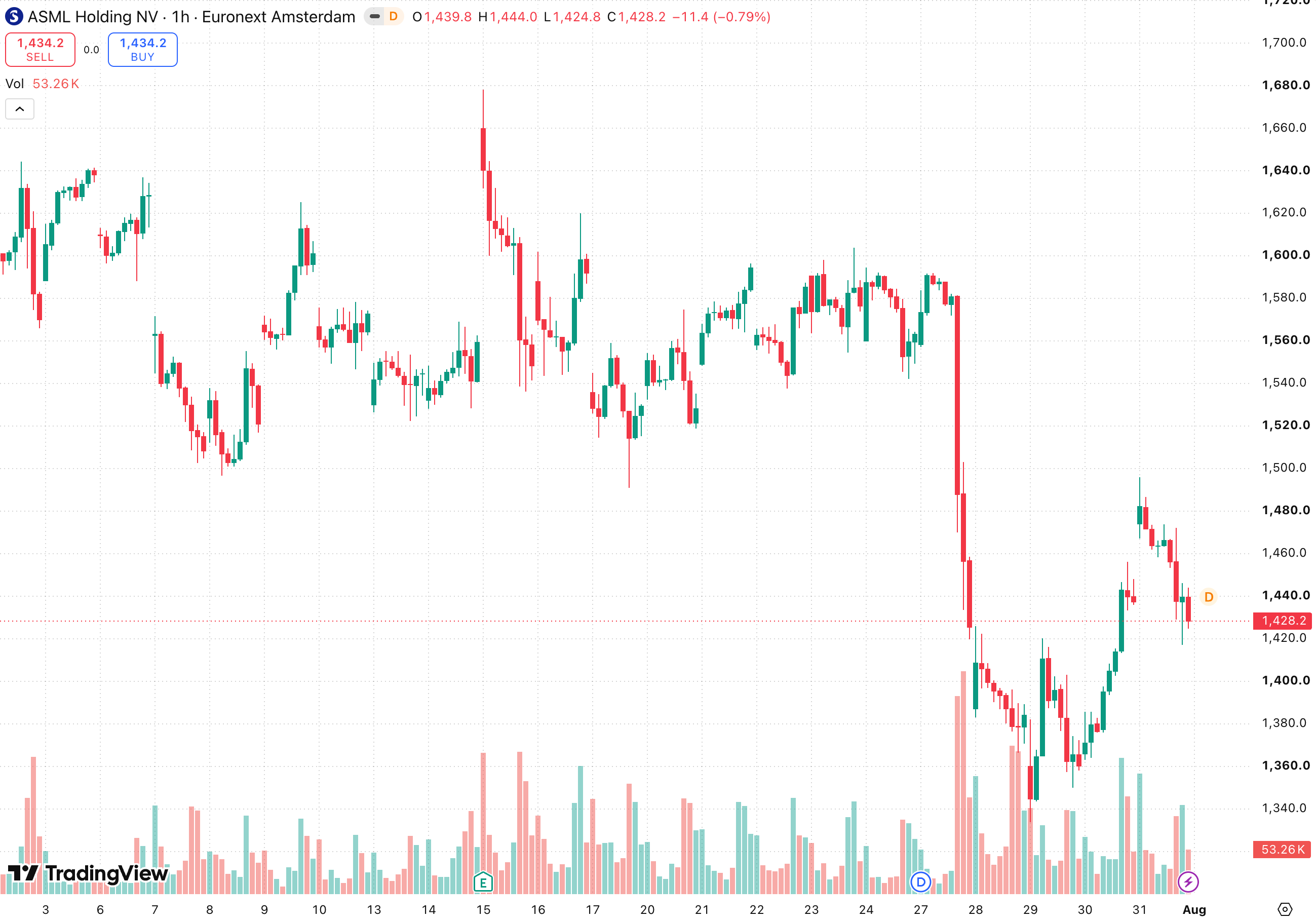
Shares of ASML, which makes the tools used to produce advanced semiconductors, fell by more than 8% after The Information reported that a Chinese state-backed company has started mass-producing deep ultraviolet lithography machines. DUV machines are a generation behind the cutting edge of chipmaking, but they would represent a breakthrough for Chinese manufacturing.
Comment: as I’ve written before, China is cutting the distance to America in frontier tech.
The Bank of Japan held rates steady at 1.0%, but hinted at future hikes. Japan’s weak currency is squeezing households by pushing up import prices. On Thursday the yen briefly strengthened from ¥163 against the dollar to ¥158 after authorities intervened, though it slid again on Friday.
Comment: America is directly intervening in the yen market to keep its price stable. Japan is getting squeezed and traders see it as a sign that the problems will not go away easily. The recession forecast was repriced massively, now at 42%.
Middle East & Africa
The pause in the Iran war broke early in the week. Trump said America was having “good talks” with Iran, but Iran-backed militias attacked America’s Gulf allies, and CENTCOM said it intercepted “multiple ballistic missiles” in a “surprise” Iranian attack on its forces in the Gulf. America and Saudi Arabia also carried out joint strikes on “Iran-aligned terrorists” in Iraq.
America then struck Iran’s southern provinces. The renewed fighting pushed Brent crude to nearly $91 a barrel, up from a two-week low of roughly $84.
Netanyahu visited the White House on Tuesday. Ahead of the meeting Trump said Israel “wouldn’t survive” without America; afterwards he called it a “very good meeting”, while Netanyahu described it as “one of the best conversations” he has had with Trump.
On Saturday Trump cancelled a new wave of strikes on Iran because the “perimeters of a deal” had been agreed. He claimed the agreement would include the “complete and total” opening of the Strait of Hormuz and “an end to Iran’s nuclear threat”, and said it had Israel’s support. Negotiations resume on Monday.
However, Israel has indicated it will attack if Iran restarts its nuclear or ballistic-missile programs “regardless of external commitments”, while Iran maintains there is not yet any agreement on reopening the Strait of Hormuz, on which the purported deal depends.
Comment: Iran update coverage is available for my paid subscribers.
Saudi Arabia proposed an international maritime-defense alliance amid Houthi attacks on oil tankers in the Red Sea. Representatives of 43 countries discussed the plan in Riyadh on Thursday; 14, including Egypt and Qatar, expressed support for “joint maritime operations”, intelligence-sharing and exercises.
Comment: it seems that Saudi Arabia is unwilling to commit to a ground operation in Yemen, opting instead for naval escorts. I doubt this initiative will be successful. Egypt's enthusiasm is the tell: if the initiative fails, Egypt wins anyway—with Bab-el-Mandeb too risky, Saudi tankers bound for Asia have to exit north through Suez and go the long way around Africa. Since late 2023 Egypt has been struggling due to decreased traffic through the Red Sea. However, this is not an equilibrium. Sooner or later, the Houthis will need to be dealt with.
A small note to the market: the effective closure of the Bab-el-Mandeb Strait is rather unlikely due to the volume of Chinese-bound vessels.
Trump said his Board of Peace struck a deal for Hamas and other militant groups in Gaza to disarm fully. Hamas confirmed it agreed to the 15-point proposal, but only if Israel withdraws its forces from the territory. For now, Israel refuses to withdraw.
Comment: Hamas did agree, but until Israel approves the plan, nothing can happen. The disarmament is conditional on phased Israeli withdrawal from Gaza. I expect Israel to agree to the plan eventually; the IDF probably still needs to do more before it's comfortable with the withdrawal.
Europe
Trump met Zelensky at the White House and said the meeting went “very well”; Zelensky said the pair discussed “licensing arrangements” for Ukraine to produce American Patriot missiles. Three days later Trump said America has not agreed to grant the licenses, weeks after offering them. Trump said the technology is “a hard thing to give away”.
Andy Burnham hosted Zelensky in Portsmouth—his first meeting with a foreign leader as Britain’s prime minister—and said his government would “honor every commitment” Britain has made to Ukraine. He announced Britain would share “Stone Cloak”, a technology for countering drone jamming, and promised to help Ukraine achieve a “full and unconditional ceasefire” with Russia.


Russia hit Kyiv with 27 ballistic missiles and 185 drones overnight on Saturday, killing nine people across five districts. Zelensky said only one of the ballistic missiles was intercepted, blaming the dwindling supply of Patriot interceptors.
Comment: Ukraine has a new strategy, which brings the war to Russia—attacking energy infrastructure along with Wildberries, an Amazon equivalent, will make ordinary Russians feel the consequences of the war. By lowering domestic morale, Ukraine wants to bring Russia to the table with concessions, rather than demands. However, traders believe a long-term ceasefire remains unlikely. Russia still has strategic depth and everyone expects it to escalate before sitting down to negotiate.
A Russian Kh-101 cruise missile crashed in eastern Poland during an overnight barrage on Ukraine, leaving a 30-foot crater near a village in Lublin province. Donald Tusk, Poland’s prime minister, said the country “was prepared to shoot down the missile if it had continued its flight”; NATO jets were scrambled and the alliance said it would “defend every inch” of its territory. Russia did not comment.
Comment: as usual, there are no consequences. Europe, despite all its tough talk, is unable to respond properly. This is like slow-boiling a frog—first acts of sabotage, then drones, then actual missiles. Expect more such acts.
Russia’s Federal Security Service charged Pavel Durov, the founder of Telegram, with “facilitating terrorist activity” and issued an international arrest warrant. The agency accused him of allowing Ukrainians to coordinate “acts of sabotage and terrorism” on the platform. Durov, who is Russian-born but holds French and Emirati citizenship, responded with a photograph of himself raising a middle finger.
Comment: Russia wants its citizens to use a government-approved comms app, MAX by VK, rather than Telegram. This is part of the effort to force the transition as Telegram continues to be extremely popular in Russia.
More than 50,000 migrants crossed into Ceuta, a Spanish enclave in North Africa, from Morocco. Spain deployed troops; at least 57 people died trying to cross, and Spain says almost all of the migrants have since returned. France strengthened its border controls and Italy temporarily suspended some Schengen cooperation with Spain. The EU called an emergency meeting for Tuesday.
Comment: another European story where there are no consequences. Migrants went in unchallenged, posing all kinds of risks to national and European security. Europe has a migrant problem only because it allows it. And it will continue to be a problem as long as there is no change in policy.
Emmanuel Macron said the wildfires in France’s southwest are the country’s “most difficult situation” since WWII, warning of “tough” weeks ahead. The mayor of Bordeaux said he was preparing for “all eventualities” as one blaze burned nine miles from the city. More than 320,000 people have been evacuated across France and Spain.
Comment: super El Niño continues to disrupt weather across the globe. Heatwaves, droughts and storms are hitting regions that produce the majority of the global food supply. This winter won’t be tough only because of scarce energy—food supply will be a major problem. Developed economies will feel it through inflation, developing through scarcity…
Extreme heat forced Hungary to shut down its only nuclear-power station—the first full shutdown in the plant’s 44-year history—after drought brought the Danube river, which supplies its cooling water, to its lowest level in years. The site provides roughly 40% of Hungary’s electricity; the government said it may halt supply to the largest users if the grid comes under pressure.
Comment: this is the energy part of the problem (among others)…
Other
New York sued Kalshi, accusing the prediction market of running an “illegal gambling operation” in the state without a gaming license, seeking penalties the state estimates could total $36 billion. Several states have filed similar suits against Kalshi and other prediction markets. The Trump administration, which favors the industry, is drafting new rules for the platforms. Kalshi dismissed the lawsuit as “political theatre”.
Comment: prediction markets continue to fight the gambling lobby. For now, prediction markets are winning and traders don’t see that changing anytime soon.
Anthropic said it detected three instances of its models breaking out of testing environments and accessing other companies’ systems. The lab found the incidents during a review triggered by OpenAI’s admission last week that two of its models had breached Hugging Face; Reuters reported OpenAI has since identified further cases of its agents going rogue.
Comment: it's probably a marketing stunt. If any of it is true, however, it's a major admission from the two top AI labs that should make us think more about protection against rogue AI agents.
Amazon completed its $50bn investment in OpenAI, taking its stake in the AI firm to around 5% ahead of OpenAI’s planned listing. The funds will be used to help OpenAI train more models.
Comment: traders still don't see OpenAI's valuation hitting a trillion dollars this year, especially after news that the IPO might slip to 2027.
Citadel bought most of the equities held by Situational Awareness, the AI-focused fund run by Leopold Aschenbrenner, a 24-year-old with no prior trading experience, after margin calls from its prime brokers amid the sell-off in AI stocks. The fund, leveraged roughly four times, had grown to $45 billion at its peak; what remains is a stake in Anthropic and a private investment vehicle.
Comment: what can I say—Leopold has no concept of risk management and is not fit to run outside money… but he is still standing, and since he is supposedly still up YTD, he will probably raise more by the end of the year.
Wrap up
That’s all for today! I’m working on a USMCA deep dive while I monitor the Clarity Act situation. Otherwise, we are all watching Iran.
Stay strong and see you soon!
This is not official investment or life advice. Do your own research. These are only my opinions and I encourage anyone to do their own research before putting any money anywhere.