


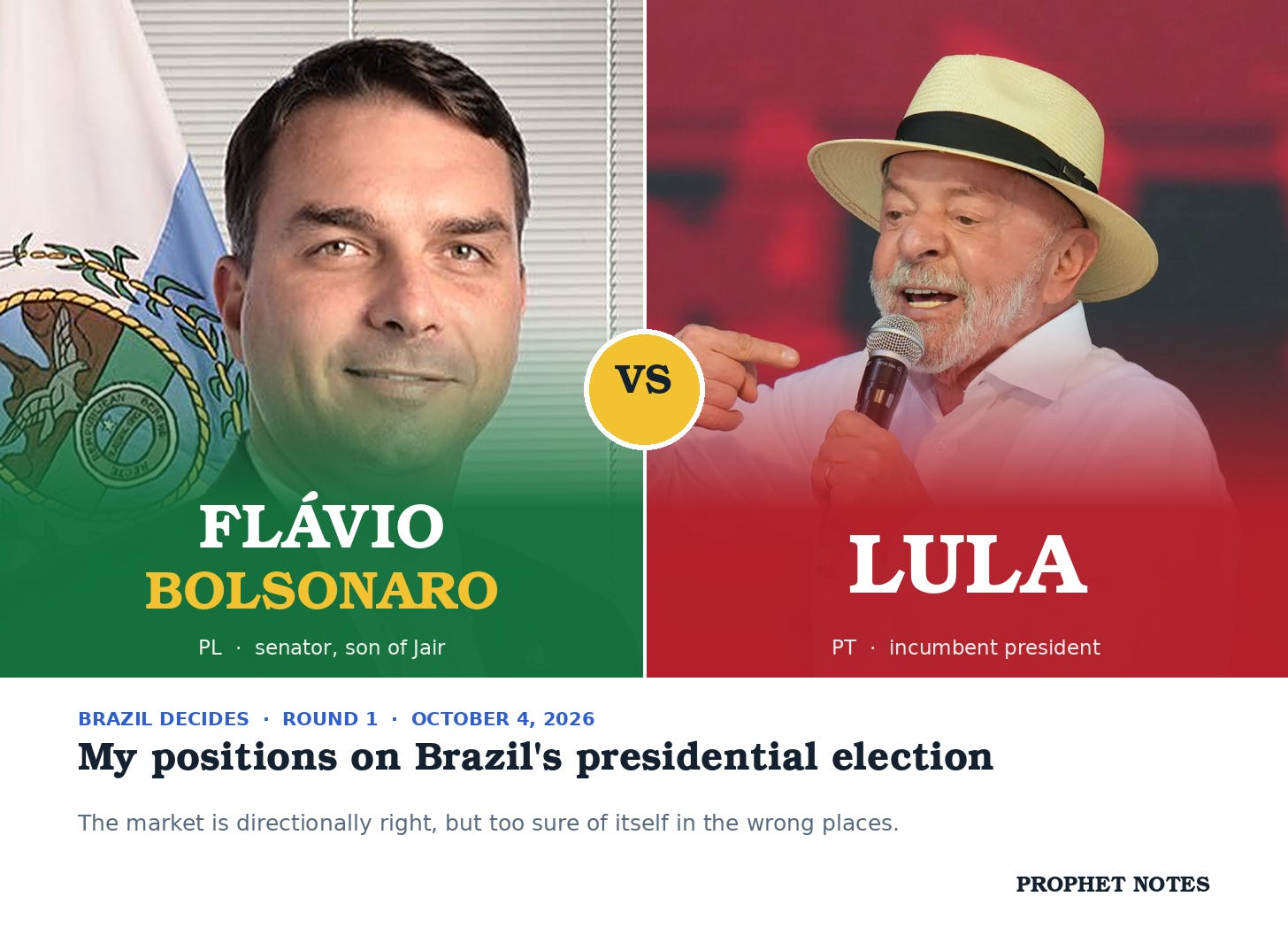
It’s been a while since I did an election deep dive. And by coincidence, it was Portugal! Now I venture again into the Portuguese-speaking world to point out where the market is wrong. And this time, I’m doing it properly.
I used to do simple models to approximate where the market is wrong (as in the Polish presidential election). Now, I’m taking my election trading a step further with proper proprietary models. Brazil is the first real test of my skill, but hardly the last one—I am building a forecast for the midterms (the Senate and Governor races, to be precise), which should launch as a series here next week.
This should be fun and profitable, so let’s take a look at Brazil.
Context
I’m going to be brief here. Lula vs Bolsonaro is like Trump vs Democrats—a decade+ battle between the right and left. Both politicians led the country at some point, but unlike in America, in Brazil the right-wing leader was eventually found guilty of attempting a coup and jailed. Now, his son, currently a Senator, is the right’s candidate, aiming to take back power and free his father.
Fundamentals
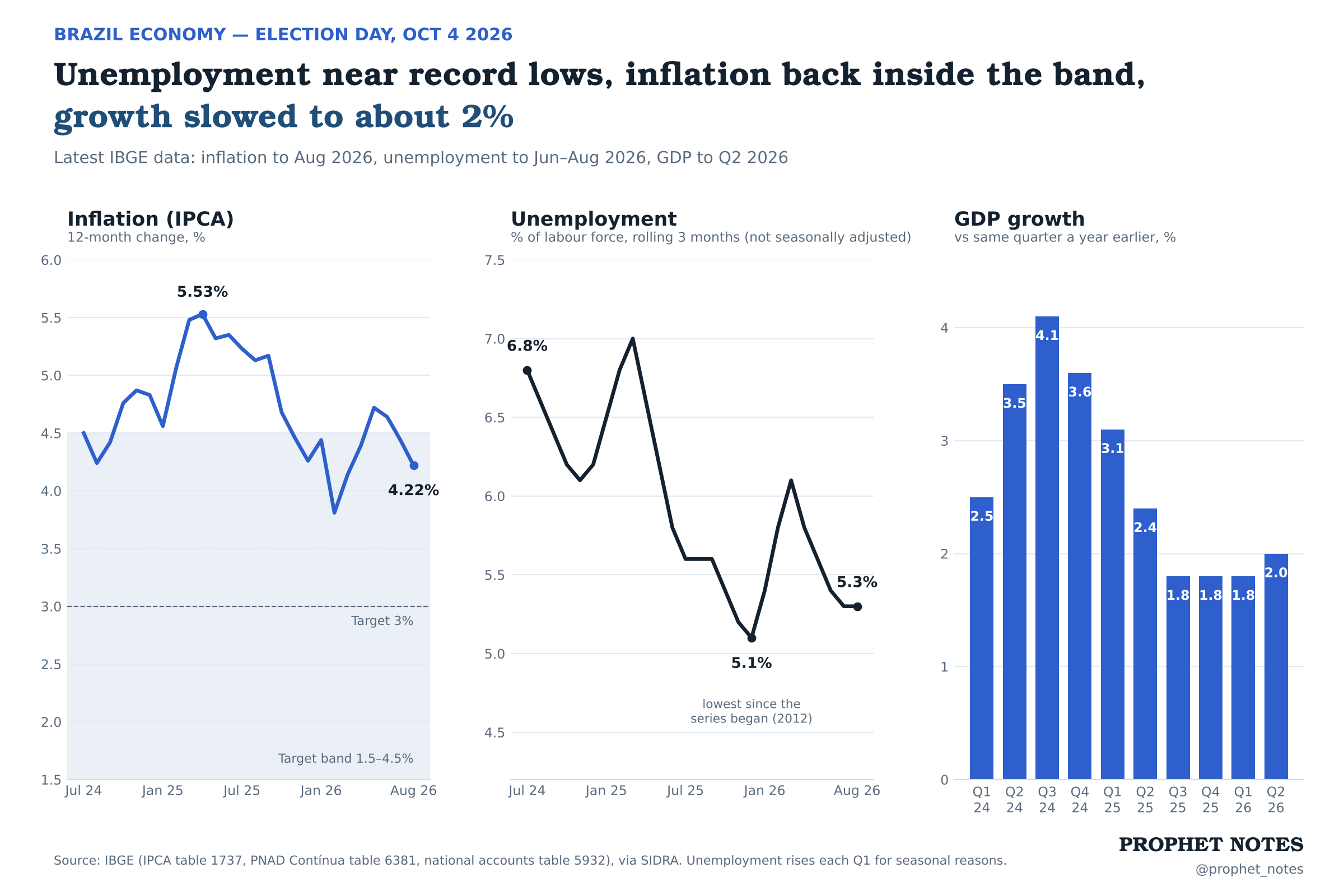
Fundamentals are slightly favoring a challenger. The labor market is robust, but slow growth and above-target inflation are working against Lula.
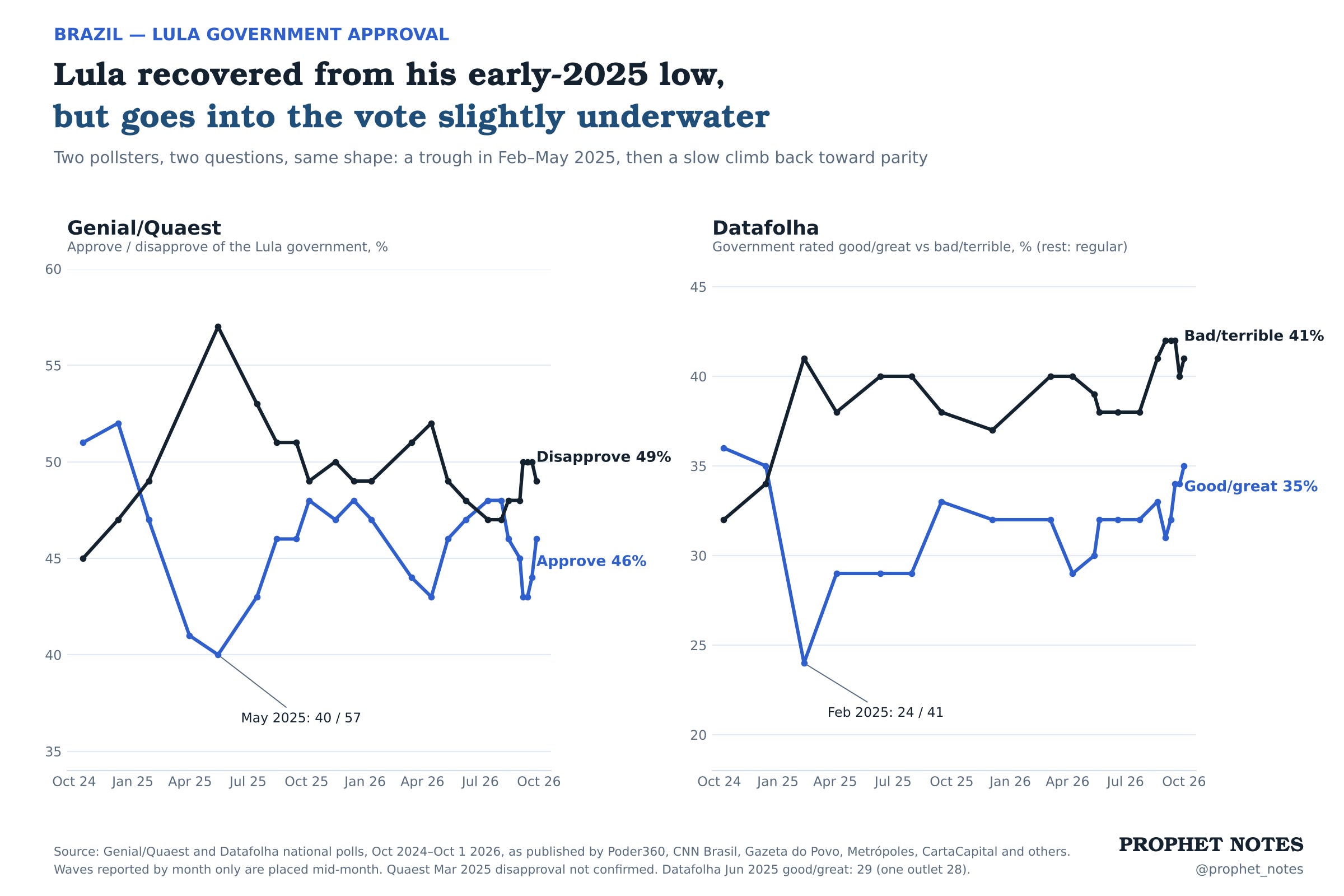
It shows in his approval rating, which never fully recovered from its early-2025 low and slipped again in September:
Political Climate
Brazilians have lived under extreme political polarization for over a decade. They are increasingly tired of the overall political climate, which shows in social surveys:
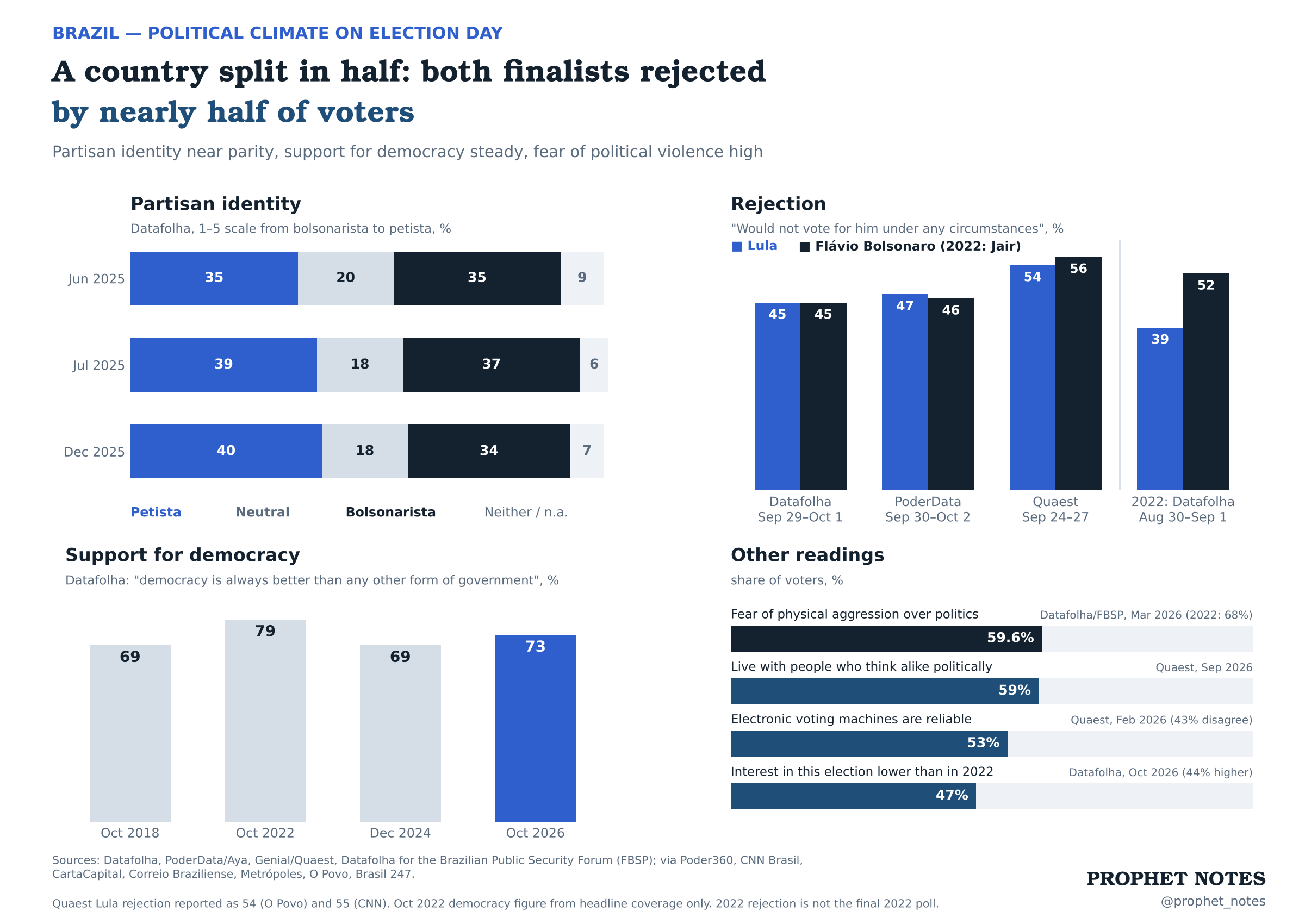
Brazilians are increasingly polarized, but at the same time disengaged; those who stick with following politics become hardline, while others become less and less engaged over time. The fear of politically-motivated violence is still high, as is general distrust among voters.
But most importantly, about half of Brazilians say this election draws less interest than 2022 (Datafolha: 47% less, 44% more). Seeing that, both contenders are trying their best to activate fatigued voters. I’ve analyzed dozens of elections in my life, and Brazil is at the frontier of political campaigning. The center of each campaign is WhatsApp, where campaigns run anything from simple coordination to gamified challenges aiming to convert new voters.
Other Candidates
When analyzing two-round elections, it’s always important to look at candidates beyond the top two. While they are extremely unlikely to achieve anything, their voters overwhelmingly tend to vote in the second round. How they transfer is key. Today, we have three contenders for the third place—Augusto Cury, Renan Santos and Ronaldo Caiado.
Cury is a bestselling self-help author (and the richest candidate per the official numbers) running as the anti-polarization candidate. He attracts voters that are tired of the current political climate.
Santos is a right wing candidate, a mix between Milei and Bukele. He attracts mainly young voters; online polls show him well above other minor candidates, but on the ground polling didn’t replicate this discrepancy.
Caiado is another right-wing candidate with a hardline stance on security. He is polling the lowest out of the three and is strongest in Goiás, where he was governor, and in the Federal District.
Forecast
My headline forecast is very bullish Bolsonaro:
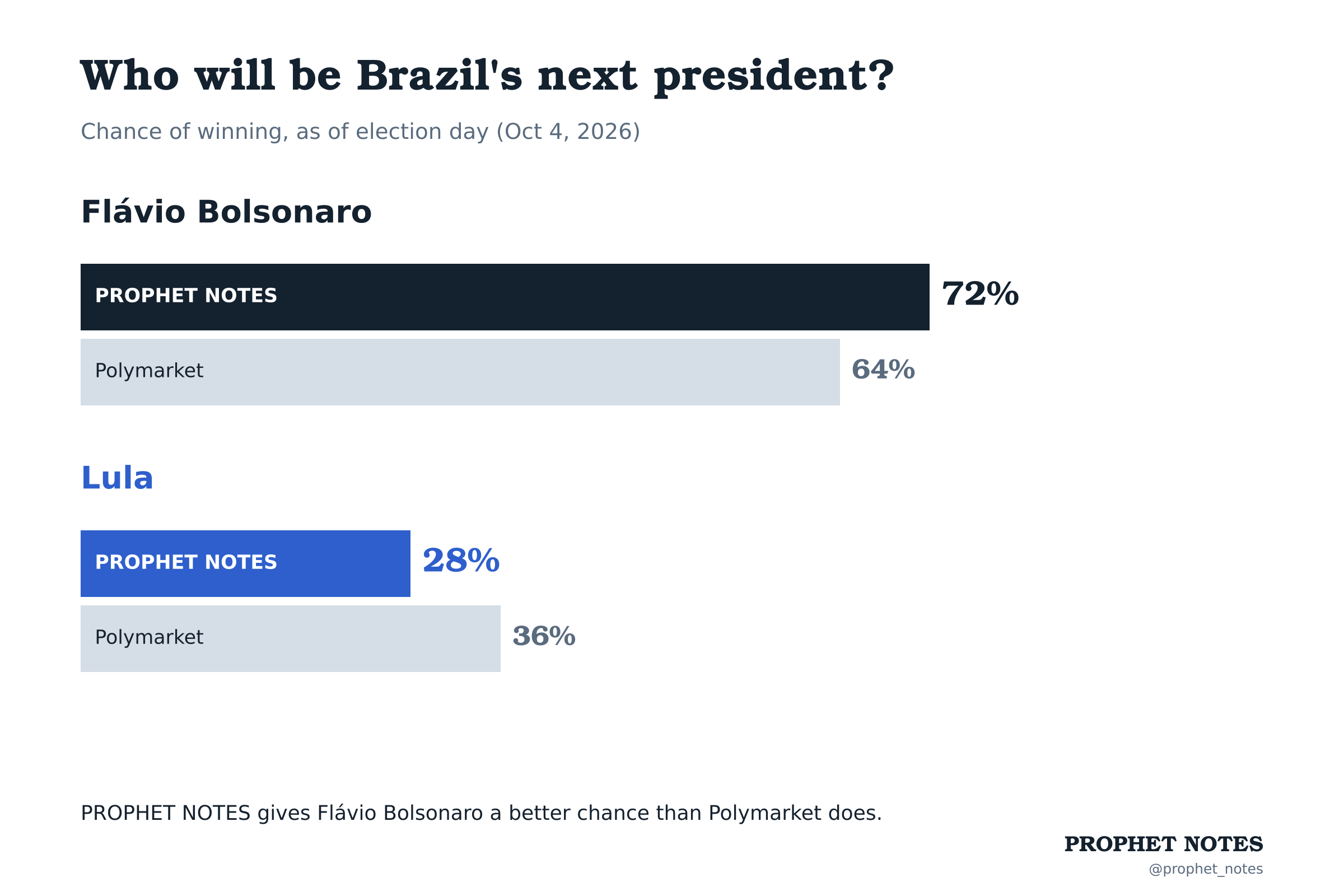
What’s cool about having a full-fledged model is that I can trace back to what exact assumptions are pushing my model away from the market. This reverse-engineering exercise is not perfect (the market price is an average of multiple models and vibe-based forecasts), but it allows me to challenge my key assumptions.
While I directionally agree with the main market, the devil is in the details. I have some disagreements when it comes to margins and order in the first round.
In the below section for the paid subscribers, I explain what assumptions drive my model, what specific adjustments diverge my forecast from the market and what is my setup for the first round.