


Welcome to another week! I’m introducing a new format for the Global Outlook. From now on prediction markets will be at the center of this series. Each week I will comment on a selection of top prediction markets based on volume, volatility and surprising resolutions across (geo)politics, elections, macro, tech and science.
This way I’ll be able to focus on interpreting the change in market forecast, rather than judging the news through a market lens.
Let’s see what changed in the world!
Weekly Outlook
US Inc.
Midterms
Darline Graham Nordone advanced to the run-off in the SC Republican Senate Special Primary. She got 33% of the vote, 17 percentage points short of an outright majority needed to get the nomination in the first round. She will now face Ralph Norman, who finished the first round with 24%.
Despite the run-off, traders now feel more confident than ever that the late Lindsey Graham’s sister will take the nomination. Initially, they were worried that the Trump endorsement wouldn’t be enough against a rather wide field. Now, the 9-point lead proves all the worries were unnecessary—my FV assessment is even slightly above the market.
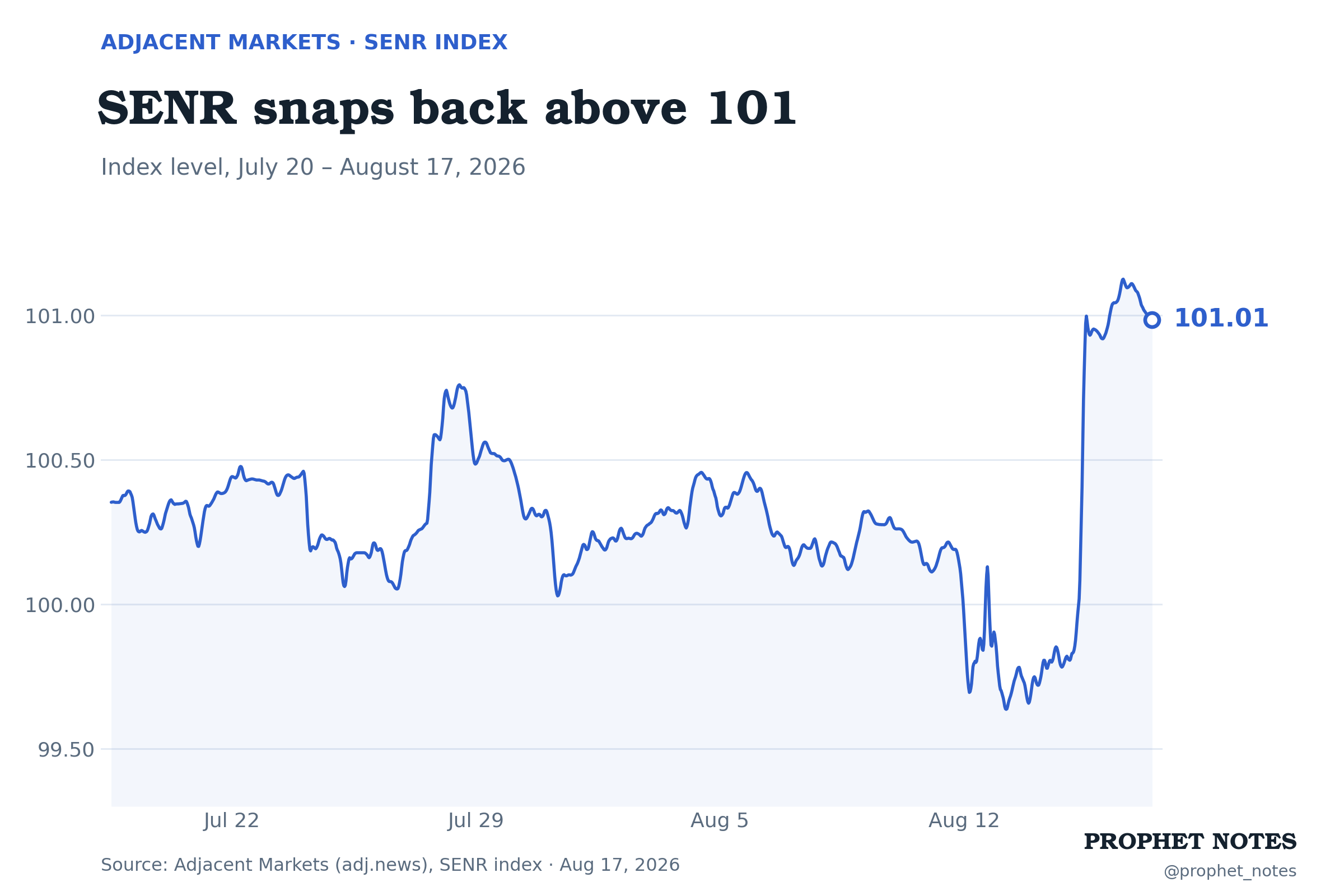
In the wider midterms forecast, we have two conflicting information sources. Adjacent’s SENR index, which currently has the 2026 and 2028 Senate races in its basket, shows a slight Republican advantage:
In the meantime, Nate Silver’s generic-ballot model shows a massive Democratic advantage:
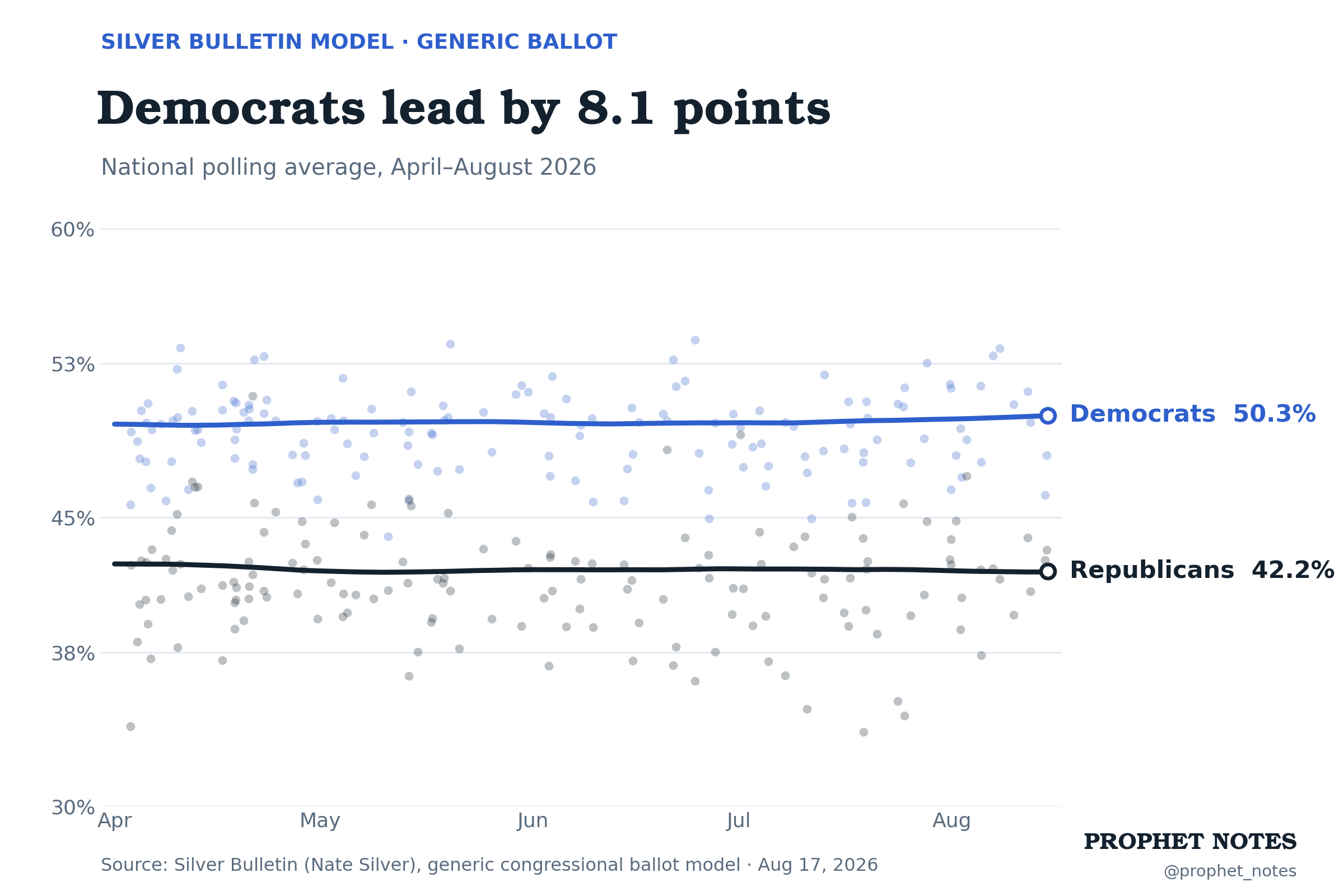
This is an interesting divergence—last week I mentioned how FLIPR’s release impacted prediction markets. The very markets that feed into the SENR index. I believe that it shows that Nate Silver, after a rather unimpressive performance in the previous elections, is no longer fully trusted—the market put a discount on his forecast.
2028 Presidential Election
We still have almost three months until the midterms, but the media already focus on the 2028 presidential election. Alexandria Ocasio-Cortez became the favorite to win the 2028 Democratic Presidential Nomination. Her rise—from a 14% chance a month ago to a 21% chance today—is fueled by rumors that she ended her relationship with her longtime fiancé. She also reportedly froze her eggs.
What does a personal relationship have to do with a presidential run? Traders believe that she is preparing for a run—freezing her eggs and splitting from a longtime partner is a strategic move if you think you will be too busy for a serious relationship (or kids) in the next few years. Additionally, the progressive wing of the Democratic Party continues to dominate the primaries.
Interestingly, Kalshi still shows Gavin Newsom as the favorite.
While AOC surged on the Democratic Nominee Market, JD Vance is widening his lead with a 47% chance to get the nomination:
Recently, Trump mentioned that in the end, it has to be JD.
The Fed
Moving to the economy, Polymarket now sees only a 25% chance of a hike in September. Additionally, a hike is no longer likely this year—traders give only a 47% chance of one by the end of the year, down from 78% barely a month ago:
All fueled by this week’s economic data dump—a relatively soft CPI print, high initial jobless claims and a disastrous retail sales report. Traders see two things playing out: first, the recent data dump suggests that the consumer is getting squeezed enough with rates at their current level; second, the midterms are coming and Republicans would do anything to prevent a hike just before the election.
The Fed cut market completes the picture: despite weak labor and consumer data, traders see only a 15% chance of a cut this year:
The Americas
Brazil Presidential Election
In the Americas, the Brazil Presidential Election is the most important upcoming event. The market continues to attract massive volume, totaling almost $4 million in the last week alone. Despite its popularity, the market is relatively flat—Lula is up 2 percentage points on the week while Flavio Bolsonaro went up by 3 percentage points. Other candidates took a hit as voters converge on the top two choices.
Flavio has been on a gradual rise for over a month now. Recently, he’s been tightening the gap and fresh polls put him within the margin of error of Lula. With the intensive part of the campaign starting soon we can expect more volatility on the market.
The first round will take place on the 4th of October and the second round will be held on the 25th of October.
Asia
Indonesia
Moving to the Eastern Hemisphere, an M7.7 earthquake hit Indonesia, followed by another M6.9 quake only a day later. At least 53 people are dead, with many more missing.
It is not a shocking development, however, as Indonesia is prone to frequent earthquakes, along with Japan, Chile and the Philippines—all four were equally likely to get the first M6.0+ quake.
Japan
In finance, traders moved their BoJ rate decision forecast and now see a 72% chance of a hike. The adjustment is caused by a weak yen performance this year combined with rising inflation. However, a slowdown in GDP growth prevented the forecast from going above an 80% chance of a hike.
The next meeting is scheduled for September 17-18.
Middle East & Africa
The Iran War
Now, the most important event—the Iran war. Last week passed with no big news hitting the headlines. We saw Axios report that America has a backchannel with the IRGC as well as signs of possible in-person talks in the UAE:


However, with no tangible progress, the chances of a final nuclear deal are going down—traders put a final deal at just 3% by the end of September and at 18% by the end of the year.
That being said, a return to wider hostilities is unlikely:
The Israel-Iran ceasefire-break market sits at 24% for the end-of-September expiry. It doesn’t mean that ships won’t continue to be struck, though.
Especially since the hopes for the Iran–Oman Hormuz Management Agreement are faltering:
Traders still see a 60% chance of one by the end of September, but even then they have several reservations. First of all, they see only a 40% chance of the US announcing an end to the Iranian blockade in the same timeframe:
As if that weren’t enough, they give an 11% chance—the No side is knocking on bond territory—that traffic through the Strait of Hormuz will return to normal by the end of September:
What does it mean? Well, traders learn—the last few deals meant to open up the strait fell short of expectations, with neither delivering a sustained surge in crossings. Ultimately, signing papers is easy; delivering results is not.
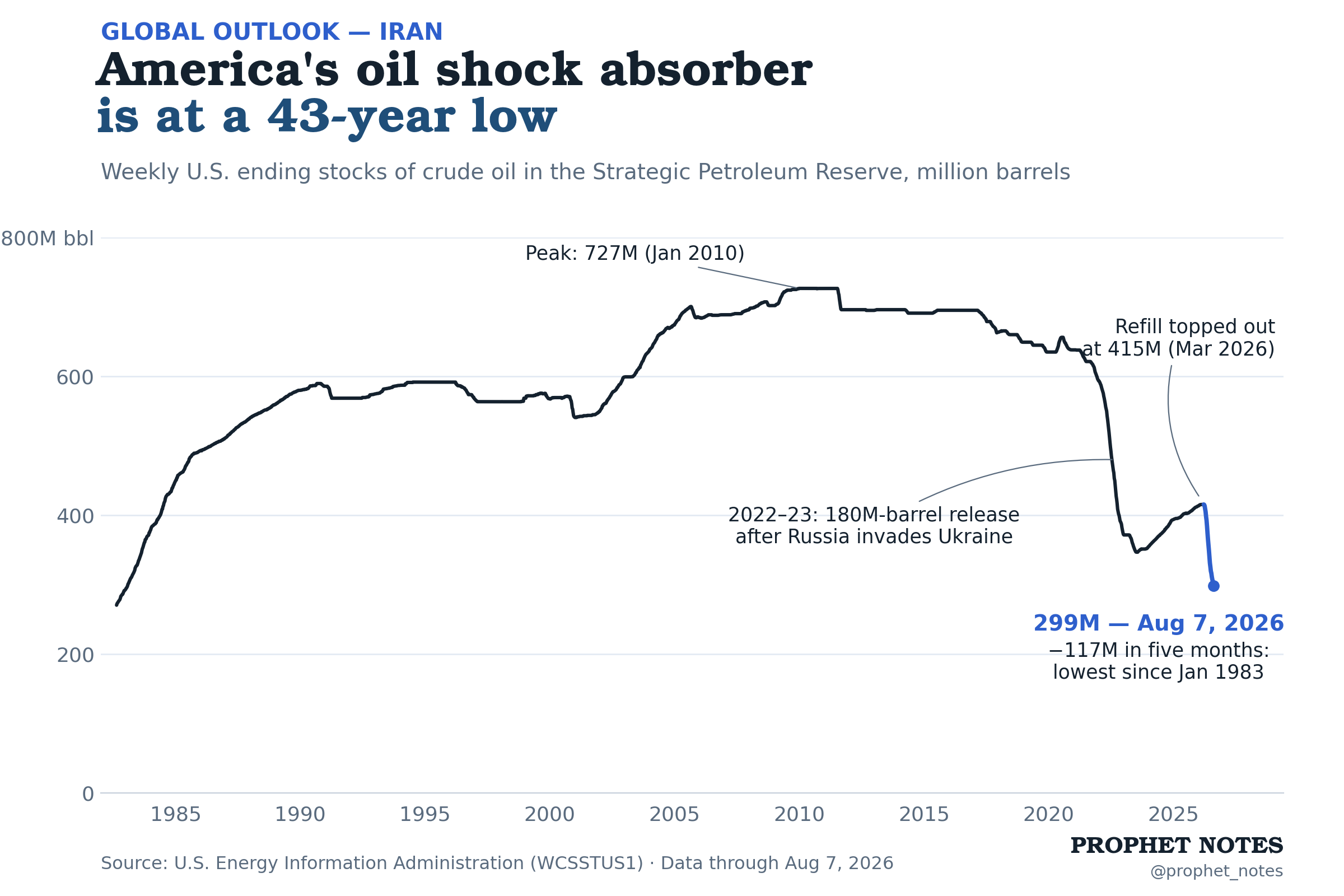
The US crude oil reserves market is aligned with the SOH-related markets. Traders see a 63% chance the SPR will fall below 285 million barrels of oil by the end of the month:
The last reported level is slightly above 298.5 million barrels of oil—but with no progress around the strait the oil must come from somewhere…
To top it all off, Iran and America are not expected to meet anytime soon:
Traders now give only a 31% chance of a meeting between the two countries by the end of September. A lack of an in-person meeting didn’t stop the MoU from being finalized, though. Chances are we will see progress regardless.
This week the 60-day MoU deadline is ending. While traders see little chance of the deadline being extended, this week should bring some news on the back of the expiring truce:
The Houthis
On the other side of the Arabian Peninsula, the Houthis maintain pressure on Saudi Arabia. Traffic is down, but the blockade is well short of a total shutdown. Traders give only a 20% chance of an effective shutdown (less than 10 crossings a day for 7 days) by the end of the year.
I think traders are overestimating here—my fair value for the end-of-year market is 10%.
Ethiopia
In Africa, an Ethiopian election that took place months ago drew the most volume of any election market last week. I suspect a lot of wash trading—the market lacks liquidity rewards and the situation is stable. Abiy Ahmed’s party won, and the only risk is that he changes the constitution and introduces a presidential system instead of taking the PM seat (yes, really).
I doubt this outlier scenario is the reason for such high volume considering that the price is stable.
Europe
The Ukraine War
The Ukraine war is escalating at a breakneck pace. Ukraine vastly improved its drone and missile production capabilities and launched a strike campaign. At first, it focused on oil infrastructure. Then, it expanded and started targeting infrastructure near major cities like Moscow. Recently, Ukraine has targeted several Wildberries warehouses (Russia’s Amazon), hitting civilian infrastructure for the first time.
Russia is not going to be passive. We are seeing rumors of mobilization along with increased drone and missile incidents on the NATO eastern flank:
In the last three weeks alone we had at least 5 incursions, including a cruise missile that struck eastern Poland:

However, Russia has a parliamentary election on September 20:
We all know what to expect, but I do think that Putin might be waiting to lock in the new government before launching a new phase of the “special military operation”. Recent escalations imply that this winter could be a deciding moment in this war.
Other
AI
Anthropic’s IPO leaks surprised traders forecasting the AI lab’s valuation. The market is now pricing in a 47% chance Anthropic will be worth more than $2.5 trillion by the end of the year.
The creator of Claude is looking for a $2 trillion valuation on its October IPO and traders see it grow with the wider market. Then again, it could just as easily go the SpaceX way—down 13% in the two months since its IPO.
Wrap up
That’s all for today! This week’s schedule is TBD outside of the Friday’s Forecast Update.
Stay strong and see you soon!
This is not official investment or life advice. Do your own research. These are only my opinions and I encourage anyone to do their own research before putting any money anywhere.