
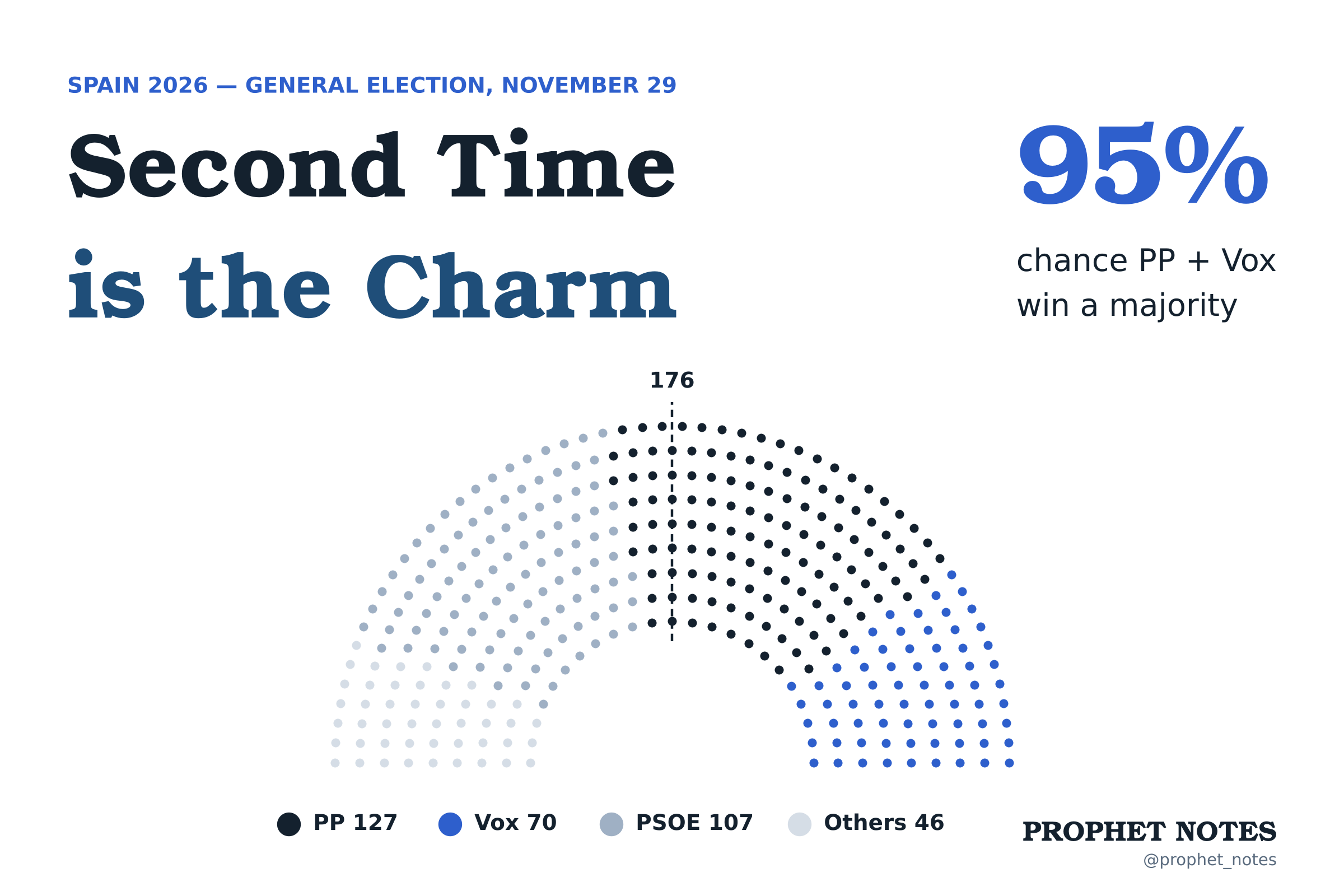
Sánchez is a cunning politician. He’s been leading Spain for eight years now, facing not only a difficult political environment, but also what he calls “lawfare” against his family and closest confidants. Even after his party, PSOE, lost the 2023 election, he managed to create a wide coalition that prevented a PP + Vox government. That little (costly) trick, however, meant that regional parties he allied with had the final say in any parliamentary proceeding.
This fragile setup imploded in early October, when the right-leaning regional parties declined to vote for the housing reform, PSOE’s main campaign promise. Now, with the election in 10 days, Sánchez is looking to repeat his 2023 “success”. But can he?
I don’t think so.
How Spain Votes
First though, I think most of you are not familiar with the details of the Spanish political system. In short, it is a parliamentary monarchy, with the executive power concentrated in the prime minister and his cabinet, who answer to the lower chamber, the Congress of Deputies.
MPs are elected through a closed-list proportional representation, calculated with D’Hondt method. The method gives a small premium for big parties, on top of the fact that small provinces elect few MPs, so the largest parties win more seats than their vote share. The chamber has 350 seats (176 needed for a majority). To become prime minister, a candidate needs an absolute majority in the first investiture vote, or more yes than no votes in the second. If no candidate passes within two months, Spain holds a new election.
Spain is divided into 52 constituencies (50 provinces + Ceuta and Melilla). Every province gets a minimum of two seats and the rest are shared out by population; Ceuta and Melilla elect one each. A party needs to have at least 3% of the valid vote in each constituency to take part in seat allocation in a given constituency.
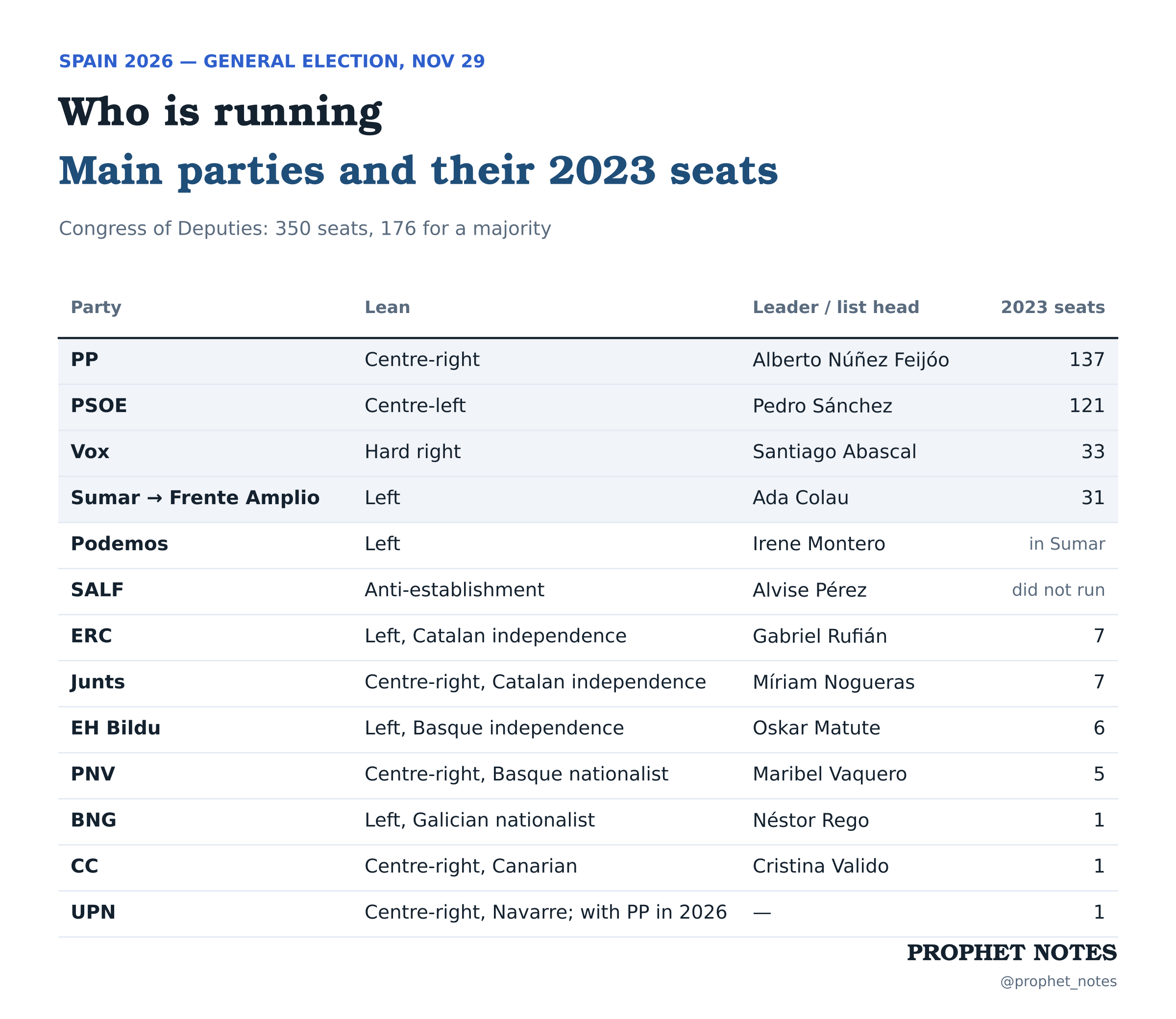
Main parties, their ideological lean and 2023 seats:
2023 and Its Aftermath
The Price of the 2023 Deal
The 2023 trick Sánchez pulled on PP and Vox came with a high price to pay. Regional parties’ support came at the price of an amnesty for those prosecuted over the 2017 Catalan independence bid. Once the law passed, some of the right-leaning regional parties (mainly Junts) stopped voting with PSOE, actively disrupting their agenda.
The following years resulted in a parliamentary deadlock which blocked any new budget (the last budget that passed the parliament was the 2023 budget bill in 2022) and virtually any legislative work. The October vote on the housing decrees was the culmination of the deadlock—its failure pushed Sánchez to call a snap election.
A Campaign Off Script
The PSOE leader wanted to center the campaign around the failed housing bill. He wanted to show that the right is blocking Spain from solving the housing crisis. His plan was derailed by a series of rather unfortunate events: first, the Urda train crash shifted focus from housing to government incompetence and corruption; second, the judiciary intensified its investigation of Sánchez’s closest circle, putting PSOE on the defensive.
Additionally, the left-wing vote split after Podemos refused to join Frente Amplio’s lists outside Valencia and the Canary Islands. With D’Hondt calculation, a fragmented front wins fewer seats, as the method rewards bigger parties disproportionately.
The Polls
The Average
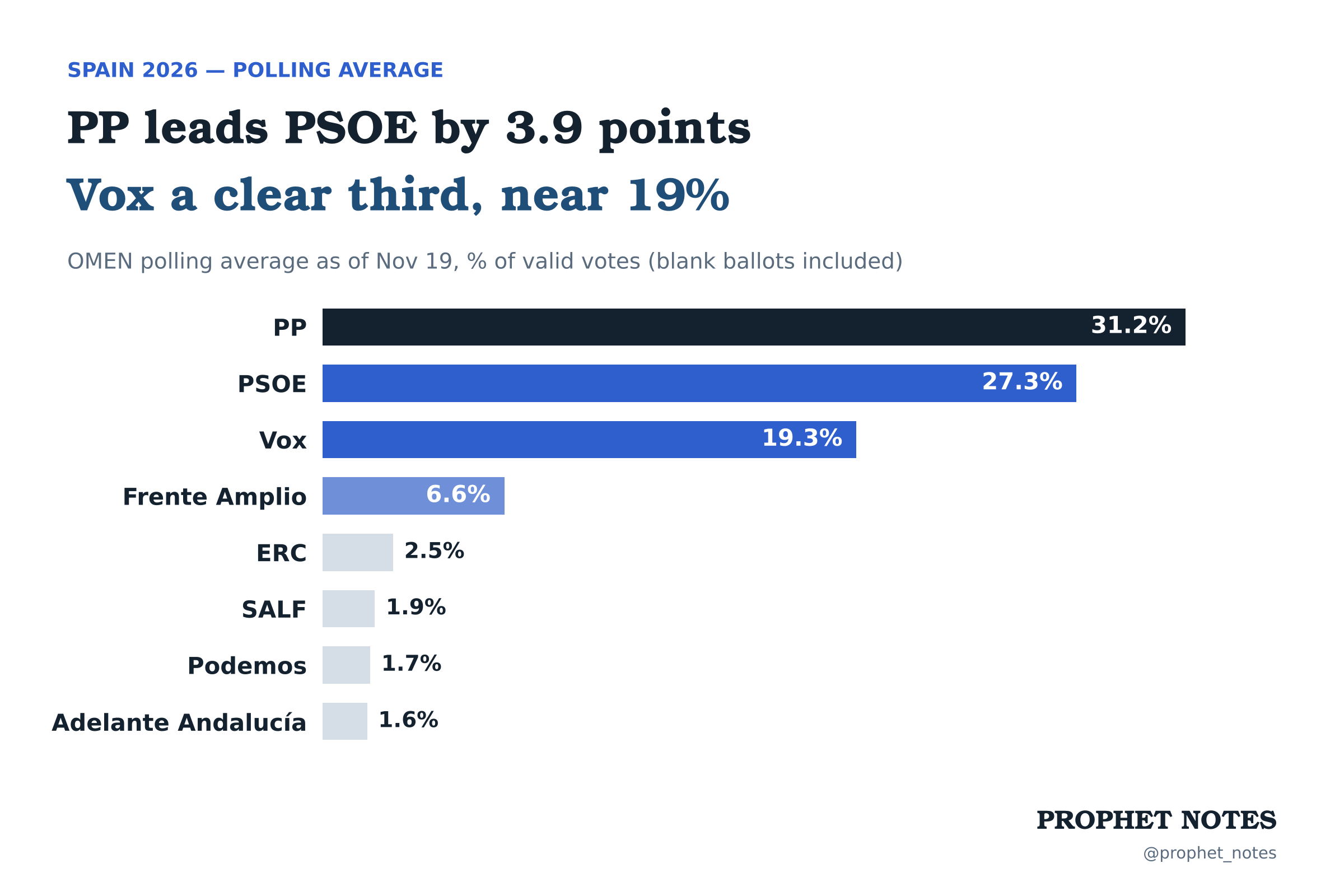
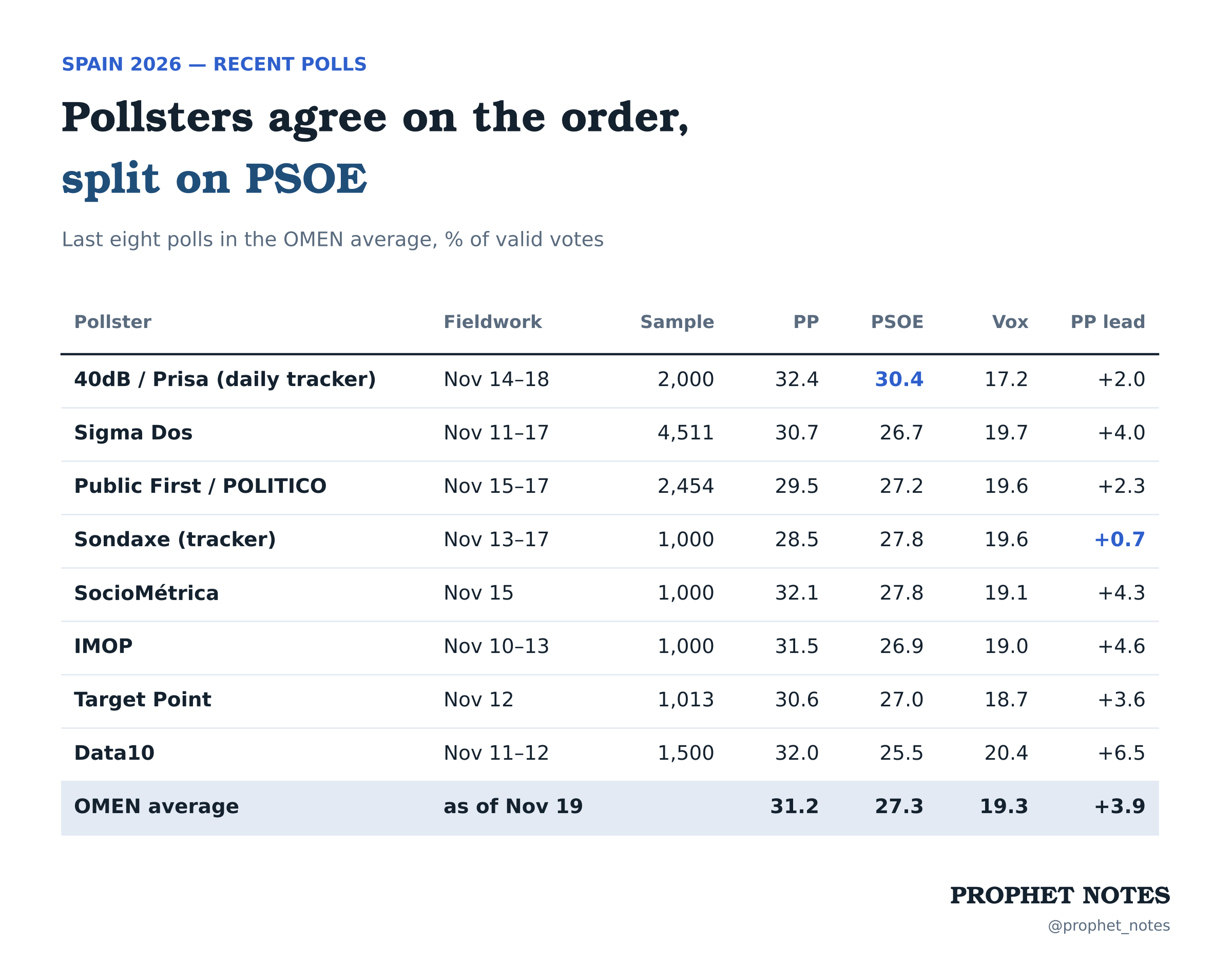
Moving to the actual campaign, my Spain polling average draws from my OMEN engine, weighting pollsters according to past accuracy and polls by recency. Pollsters generally agree on the order of parties and are roughly aligned on vote share. The only real outlier is PSOE, which gets anything between 25.5% and 30.4% in case of the 40dB daily tracker:
The 40dB Question
40dB is a middle-of-the-pack pollster when it comes to past accuracy. Personally, I don’t like their daily tracker methodology—without adjustments, it artificially inflates its importance in the polling average. It is the most likely reason for the recent market move against PP. Well, this and the fact that 40dB is widely cited by Spanish media.
Other pollsters showing PSOE ahead do not weight raw data by 2023 vote, which makes their results hard to compare with real outcomes and other surveys.
Two Caveats
Looking at recent history, polls understated PSOE in 2023. Yet the last four regional elections were all won by PP, suggesting that this time their lead is accurate and safe.
And the last comment on the polls before the forecast. Spain bars poll publication in the last week. Andorra, however, doesn’t care and publishes polls up until the election day—looking at them is essential to price in the effects of the last campaign week.
The Forecast
My forecast takes the polling average, then it simulates the seat distribution based on previous elections and regional results. On top of that, I add judgment calls to complete the picture with more qualitative data. Essentially, it’s a hybrid of a poll-based model and a Tetlock-style approach to forecasting, where my inside view is the last layer of the model.
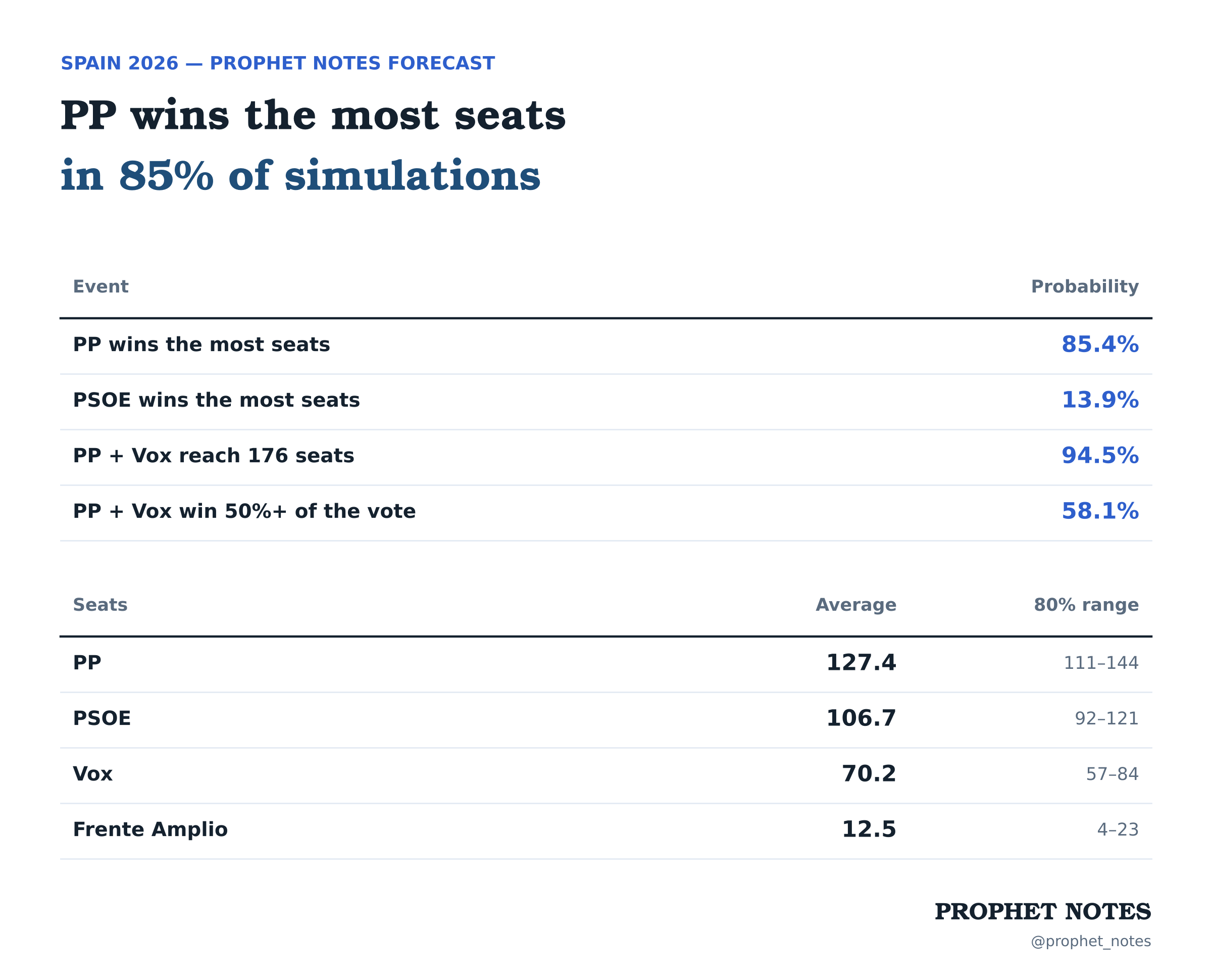
At 10 days until the election, I have PP as a strong favorite to win most seats. The combination of unfortunate events for PSOE with the recent regional election record makes me confident they will deliver the win.
Keep reading with a 7-day free trial
Subscribe to PROPHET NOTES to keep reading this post and get 7 days of free access to the full post archives.