


Welcome to another week! For the new readers: every week I comment on the top prediction markets—selected by volume, volatility and surprising resolutions—across (geo)politics, elections, macro, tech and science. Markets first, news through their lens, not the other way around.
Let’s see what changed in the world!
Weekly Outlook
US Inc.
Midterms
The biggest news this week on the midterms comes from Missouri. The Supreme Court of Missouri ruled that the new congressional map is not valid and that the voters should decide in November whether to introduce it.
The MO-05 seat winner depended almost entirely on the shape of the map—with the decision the seat flipped from an 84% chance to be Republican to an 80% chance to be Democrat, even after the state AG directed the case to the SCOTUS.
A Democratic sweep is now the base case, at 52% with less than two months to go. But it’s hardly because of the congressional map—Republicans are hurting mostly because of the downstream effects of Trump’s choices during the last year. Ultimately, the price at the pump and the frustration of every grocery bill are what pushed people away from the administration.
At the same time, Trump is preventing the Republican candidates from distancing themselves from him. The upcoming midterms convention in Dallas, the first of its kind, centralizes support (or lack thereof), further complicating the situation for swing state nominees.
If the GOP wants to fight for the Senate and prevent a Blue wave, the convention needs to be a new beginning rather than a victory lap. Let’s see if Trump manages to surprise us. For now, I don’t see the convention becoming a material advantage.
The Fed
In the middle of the political discourse is the Fed. With the upcoming midterms and the ongoing Iran war, its rate decision is one of the most important in recent years. Everyone knows that a hike immediately before an election hurts the ruling party. But underneath there’s an even bigger issue to understand.
We are in a major supply shock thanks to the Iran war. Decreased supply of raw materials causes shortages in poorer economies and inflation in developed ones as they need to pay more to secure deliveries (or, in other words: developed economies outbid the poorer ones for essential supplies). Unlike demand shocks, which can be directly mitigated by monetary policy, supply shocks cannot be solved by printing dollars. The only thing monetary policy can do in the face of a persistent, structural supply shock is to raise interest rates to destroy demand.
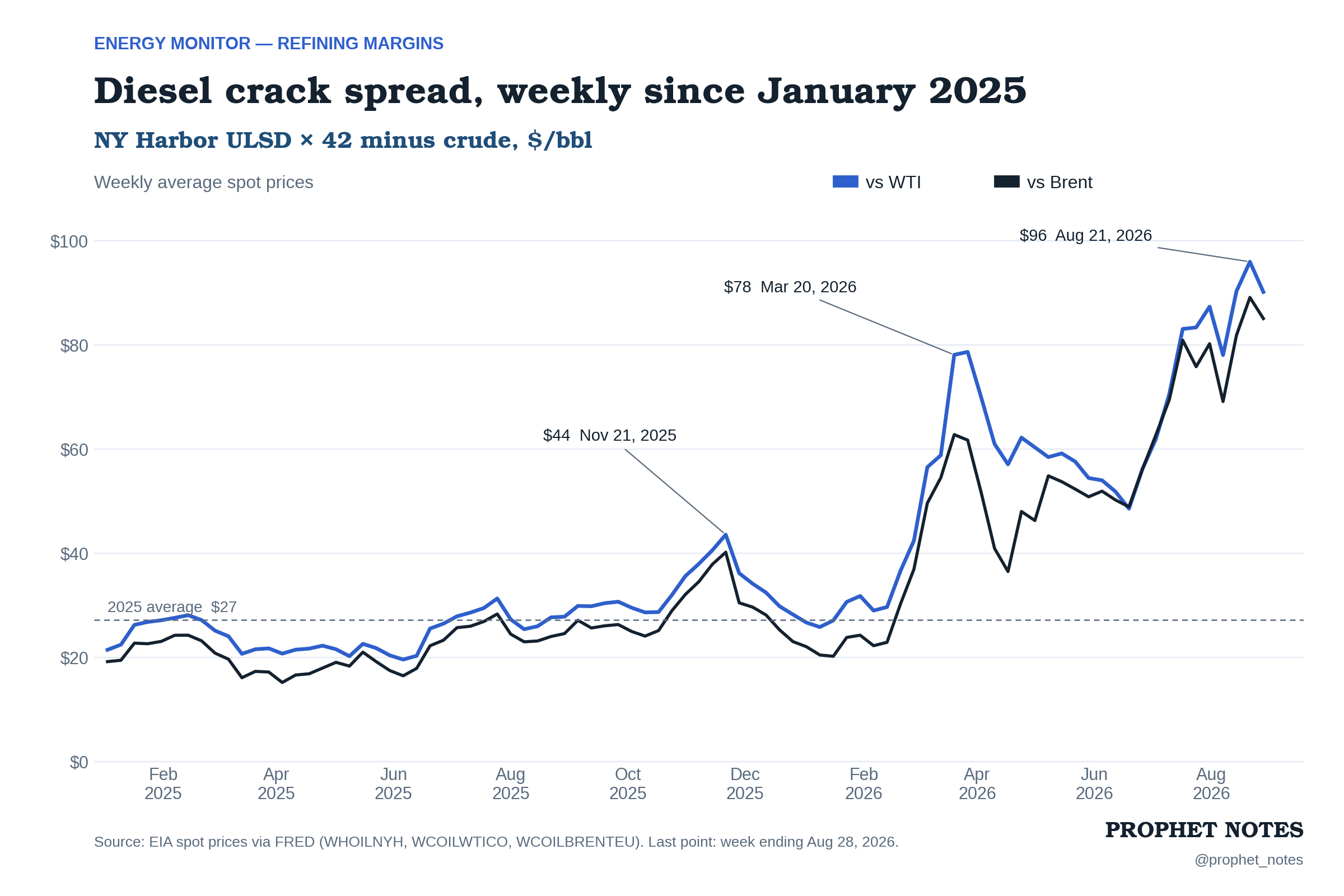
Higher interest rates curb spending and help control shortage-induced inflation. Demand destruction is essentially a fancy name for inducing a controlled recession (or at least deceleration in growth). So far the Fed has refused to hike. Inflation has been manageable, and there were hopes the Iran war could end soon.
The Fed’s decision to hike now would mean that it coordinated with the Trump admin and made a conscious decision to start destroying demand across the economy. It doesn’t look like we are anywhere close to that point with the midterms two months away and still some time to change course.
The Americas
Brazil Presidential Election
During the week, Flavio Bolsonaro’s chances of winning the election stabilized around 40%, with Lula in the 55–57% range. Recent polling puts both neck and neck:
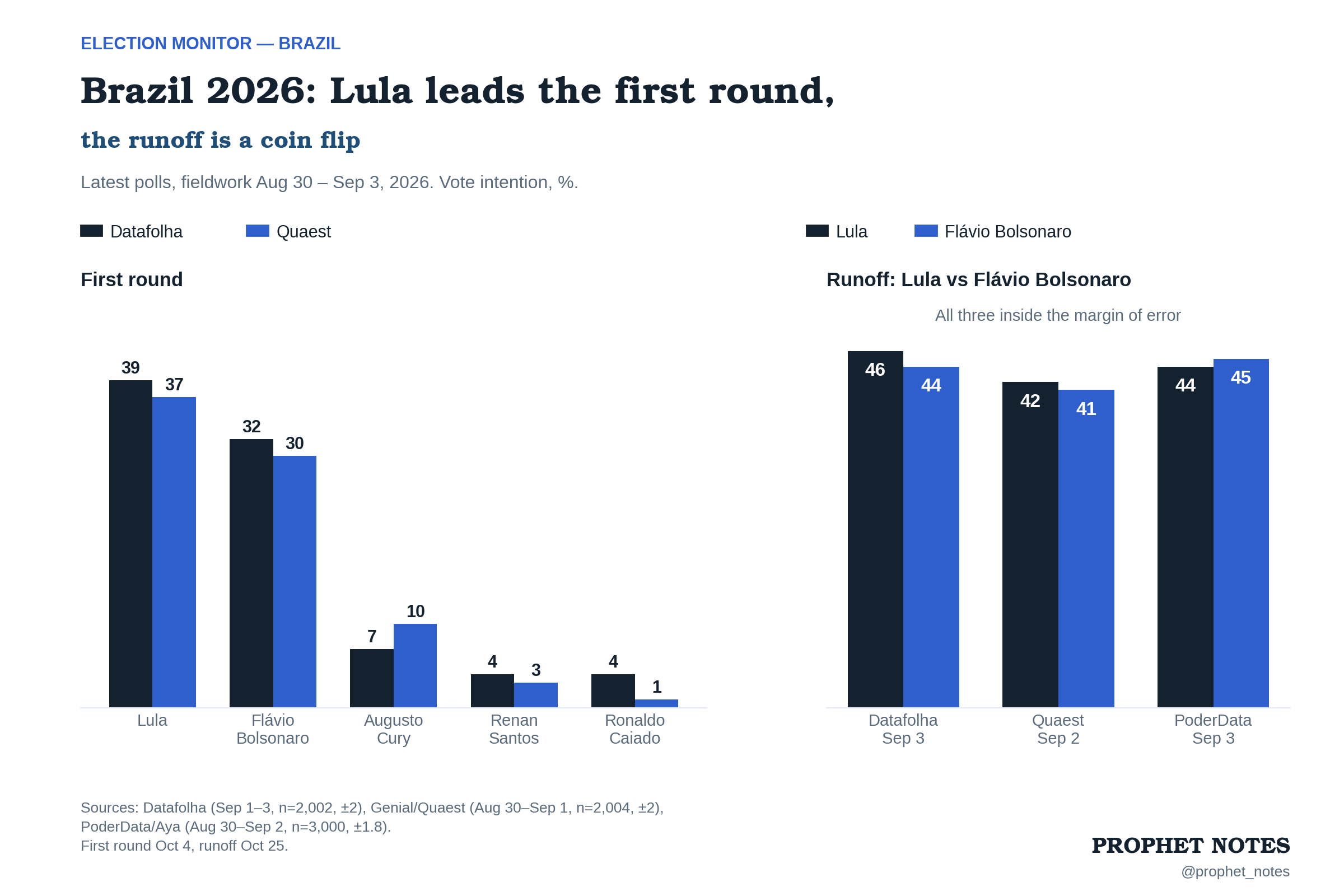
Polling numbers resemble the 2024 US Presidential election, where Kamala Harris held a slight lead in the weeks leading up to the election. From my point of view, the polls are within the margin of error. Intuition says Bolsonaro, but I don’t have a proper analysis yet—I may do a deep dive in the coming weeks.
Asia
China
In Asia, SCMP reported that China is stepping up its preparations to blockade Taiwan. The markets on the China x Taiwan invasion or clash, however, are flat.
Blockading or invading Taiwan is the riskiest and most expensive option for reunification. Ultimately, traders believe that a death by a thousand cuts is the strategy and blockade options are being prepared as a threat.
Middle East & Africa
The Iran War
The Iran war is stable, as far as wars go. Last week’s developments can be summarized as “tanker wars”—both sides are now targeting shipping through the Strait of Hormuz. Since Iran implicitly agreed that Hezbollah alone needs to deal with Israel in Lebanon, the focus has been on materials flow.
Iran needs to force America into concessions by imposing unbearable costs on the global economy, while the US needs to sustain the flow to extend its runway:
As a result, sentiment is at its lowest level ever:
At the same time, the cracks in the global economy are becoming more apparent by the day:
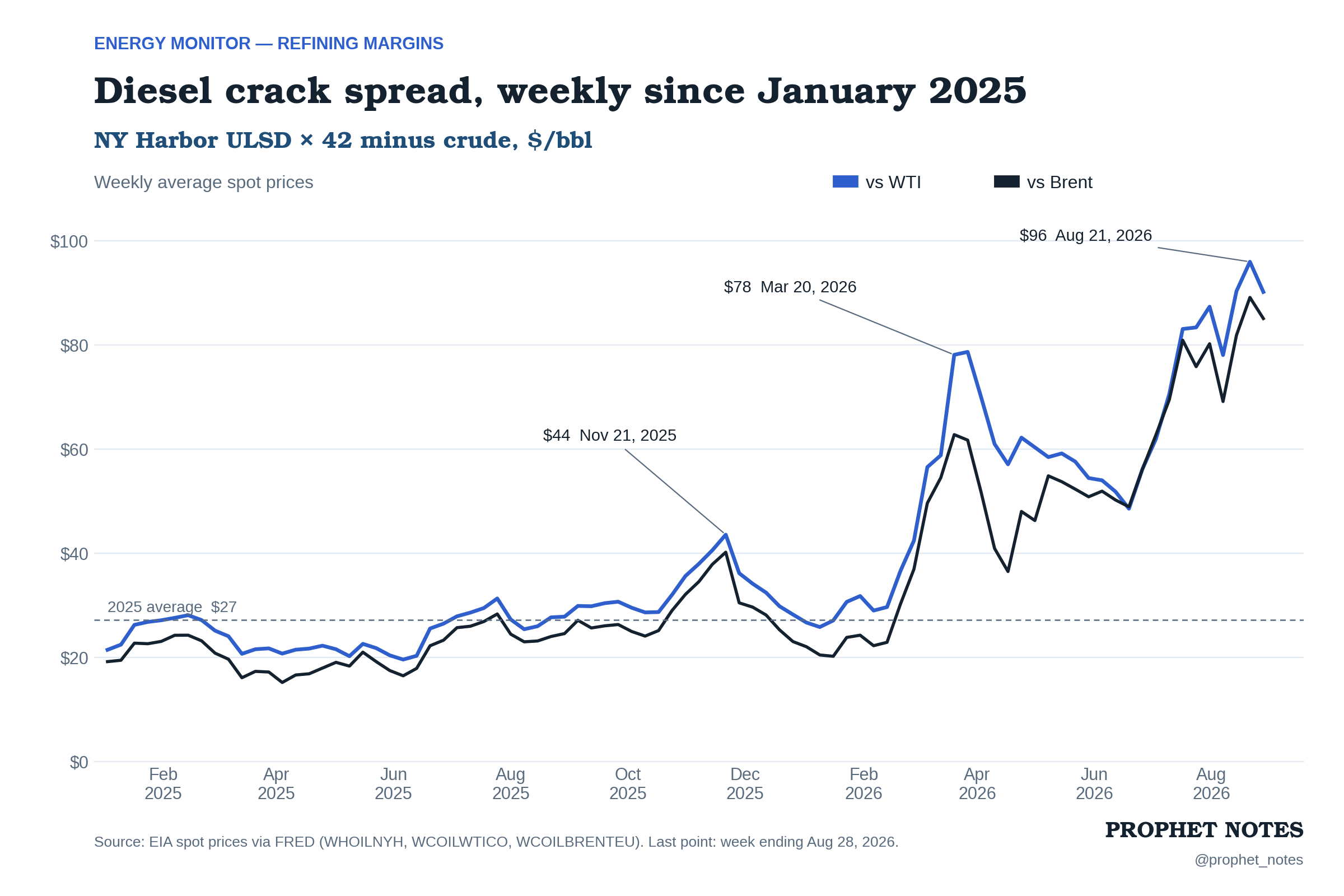
For now, Trump thinks he can end the war in Ukraine and unlock Russian raw materials. Pretty soon, he will find out how wrong he is and scramble for either a hasty deal with Iran or… export controls. I believe the topic of the Iran war will be crucial in the next two months, especially since the “tanker war” only makes the structural damage to the economy worse.
I have a long-running thesis on the Iran war and positions built around it, and I believe that the markets are severely underpricing the possibility of a deal now. You can read the latest update to my thesis here, along with my assessment of the Ukraine war and my view on the upcoming Fed decision:

The Houthis
On the other side of the Arabian Peninsula, the chance the Houthis close the Bab-el-Mandeb Strait rose sharply on news of the Houthis fighting to reclaim land adjacent to the strait. Traders see it as a move to reassert control of that land. It will give them more control of the waterway, thus making their threat of closure more credible.
I still see the cost of a total blockade as too high, but my fair value has increased slightly as well.
Israel
Israel itself is now focused on the upcoming Knesset election. After last week, Eisenkot stabilized at a 50% chance to be the next prime minister, while Netanyahu is at 30%. Polling is still extremely close, with neither sure of a majority:
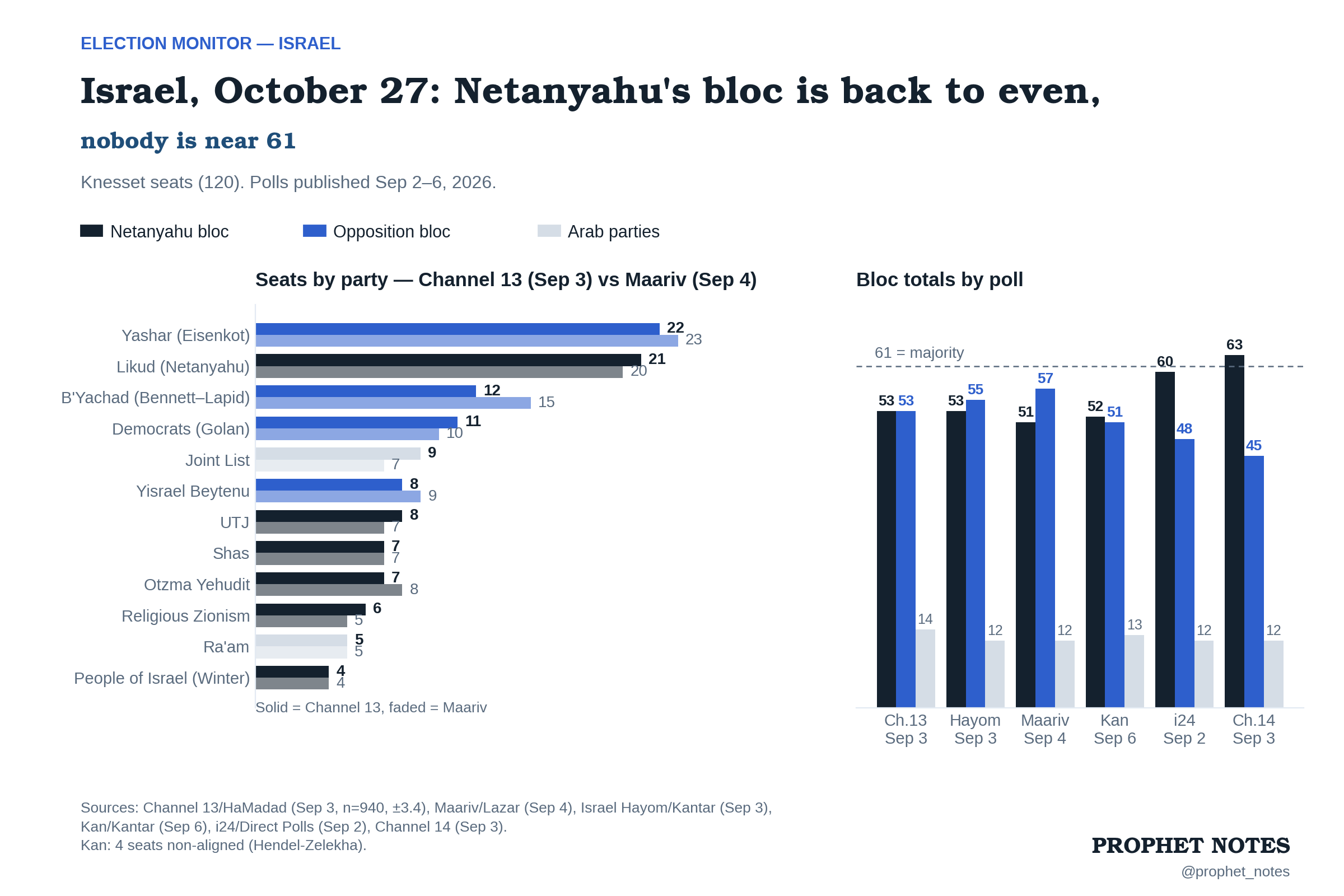
I will be watching how the Iran war developments impact the election, especially if Trump goes for a hasty deal.
A tricky Israel market also revealed itself this week:
Turns out, Israel routinely closes its airspace on Yom Kippur, which is enough to satisfy the rules—the market repriced from 9c to 78c once traders realized their mistake.
Europe
The Ukraine War
Kushner and Witkoff traveled to Moscow and Kyiv during the weekend to meet with Putin and Zelensky in an effort to make peace. Talks were described as “very meaningful”; rumors have it that the envoys discussed post-war cooperation with Russia.
Since Trump is desperate for a win, the vagueness signals a lack of progress. Chances for a short-term ceasefire are only slightly up, while a long-term armistice is even less likely than before the meetings:
Trump’s effort to end the war, instead of focusing on Iran, was doomed to fail from the start. August marked the month Russia intensified provocations against European nations:
It was also the month rumors of a new mobilization in Russia hit the tape.
I’m extremely bearish on a peace deal in Ukraine, with my fair value below 5% this year.
Germany
AfD won 39 out of 83 seats in the Sachsen-Anhalt election. While traders expected AfD to win, they didn’t see such an outperformance:
AfD fell just three seats short of an outright majority—the closest a far-right party has come to governing alone in a German state since WWII.
Other
AI
Lastly, AI. Two new frontier models dropped this week—Anthropic updated Fable, and OpenAI released GPT-6 Astra, the first in a new series.
After a period of total dominance by Anthropic, OpenAI is once again challenging the leader when it comes to benchmarks—traders now give a 15% chance OpenAI will have the best AI model this month, up from 3% just days ago.
Did you have a chance to test Astra? Do you think it’s materially better than Fable? Let me know in the comments.
Wrap up
That’s all for today! The schedule for the week is TBD, outside of the usual commentary.
Stay strong and see you soon!
This is not official investment or life advice. Do your own research. These are only my opinions and I encourage anyone to do their own research before putting any money anywhere.